
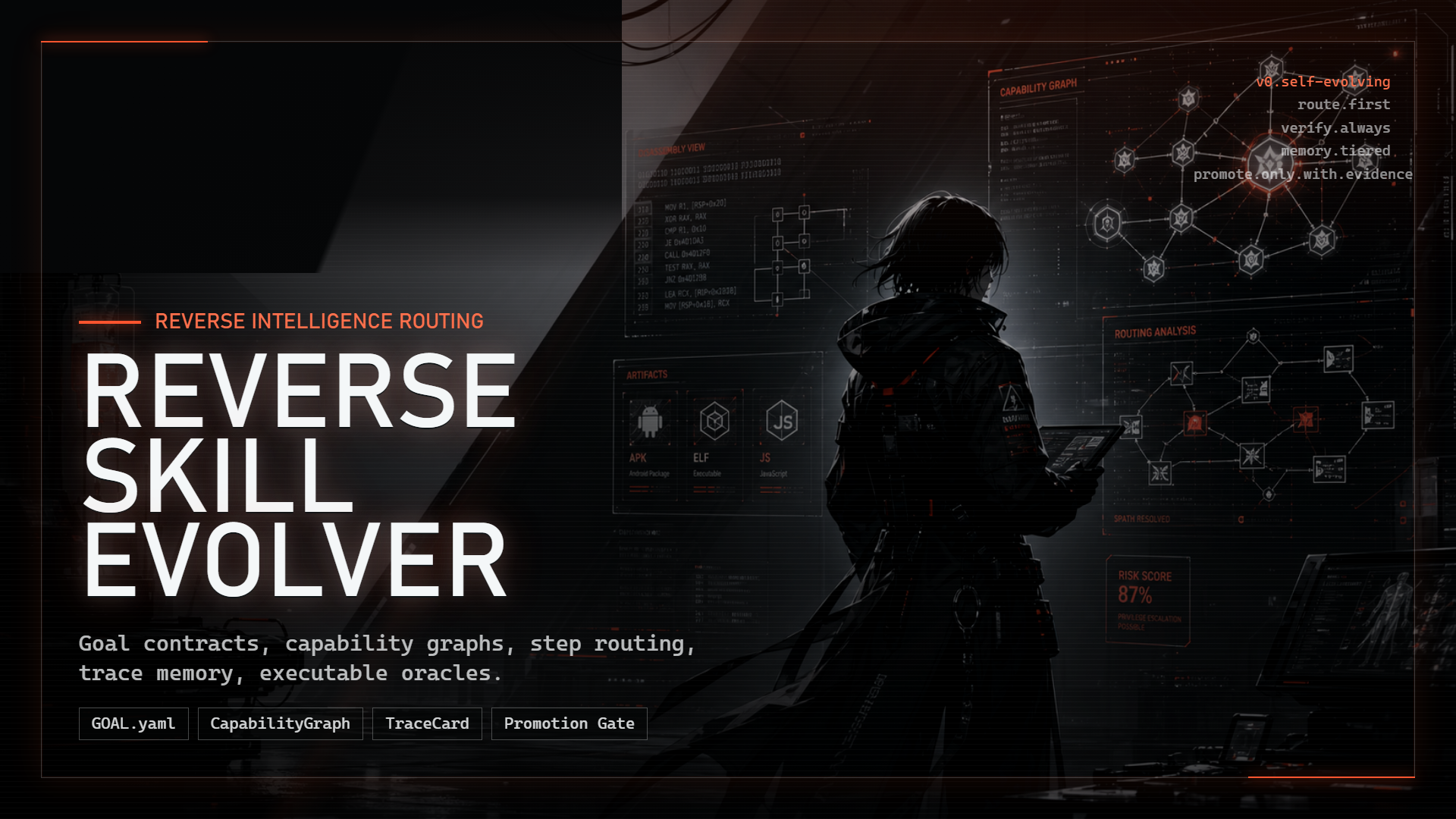
Reverse Skill Evolver
This directory is one complete installable skill. Its skills/ and
CTF-Sandbox-Orchestrator/ directories are bundled modules and resources.
Keep the directory intact when installing or updating it.
Locate the package
Resolve paths from this SKILL.md, regardless of the caller's working directory:
<PACK_ROOT>: the directory containing this file.<SKILL_ROOT>:<PACK_ROOT>/skills.- CTF modules:
<PACK_ROOT>/CTF-Sandbox-Orchestrator.
Read and execute referenced module files in this installed package. Their relative paths depend on the bundled layout. Client registration is handled by the skill installer; using this skill does not require global rule injection.
Route the task
- Use the current task's inputs, authorization, requested output, and success
checks to select a route. For multi-step work, use
skills/evolution/goal.template.yamlandskills/evolution/SKILL.md. - Read
skills/routing.jsonandskills/routing.md, then the selected module'sSKILL.md. An explicit Forefy ASR request entersskills/asr-registry/SKILL.md. For a deterministic suggestion, runpython "<PACK_ROOT>/scripts/run.py" --json route "<task>".selectedreports a route recommendation; tool availability and the current task's authorization still need verification before executing the workflow. - Consult
skills/ROUTER.mdfor shared tool discovery, bootstrap, reporting, and journal conventions when those parts of the workflow apply. Tool availability and external service configuration are separate from installing this bundle. - Execute the requested workflow within the current authorization. Preserve evidence for results and route changes. Apply the evolution promotion gate to learned changes before treating them as stable routing knowledge.
Python CLI
Use the bundled launcher whenever a module needs reverse-skill:
python "<PACK_ROOT>/scripts/run.py" --help
python "<PACK_ROOT>/scripts/run.py" --json asr list
Python 3.10+ is required. On first use, the launcher creates a private runtime in the user's cache and installs this package and its declared dependencies. It preserves the caller's working directory, arguments, JSON output, and exit code, with UTF-8 output and imports isolated from the caller's Python environment. Setup diagnostics go to stderr. A setup failure stops before the CLI operation runs and reports the actual error.
For PowerShell, shell, and module-local helpers, use their bundled paths as documented by the selected module. Native tools and MCP services are prepared only when the requested workflow needs them.
Case records and optional project index
Create an explicit case record with case init --hint "<task>" --case-name NAME --package-root "<workspace>". It records declared scope and network mode and
creates work/NAME/; it does not execute an analysis or grant authorization.
Use skills/case-review/SKILL.md for scope, evidence links, timeline and artifact
hash review. JSON failures retain output-v1's data=null; their error message
includes the diagnostic report.
For a large workspace, index build "<workspace>" returns a plan. Only
--apply creates .reverse-skill/index/v1.sqlite3; index update follows the
same rule. retrieve "<workspace>" "<query>" --mode bm25|tree|hybrid reads the
existing local index. Indexing is optional and does not change skill selection.
Use gates all to check repository versions, CLI descriptions and routing
paths; gates leak-scan "<path>" explicitly scans selected files with redacted
findings. All commands use the bundled launcher above.