
Commit Message (Conventional Commits v1.0.0)
Trigger phrases: "commit message", "make a commit", "conventional commit", "write a commit", "git commit"
Format: type(scope): summary + (optional blank line + body) + (optional footer).
The project decides the format and the language — read that FIRST
Conventional Commits below is the default, not a law. Before writing anything, read ./CLAUDE.md for a
## Conventions section (Commit language: / Commit format:). A declared format REPLACES the shape below —
ticket-prefixed subjects, smart-commit trailers (#comment, #time), gitmoji, whatever the team runs on. A
declared language replaces "the project's established language" guess. Nothing declared → the defaults here.
Whatever the request hands you verbatim — a ticket id, a #time 1d, a required prefix — goes into the
message EXACTLY as given. Rewriting a literal someone typed is the worst failure this skill has: it looks
correct and books the wrong number. If a literal contradicts the format, say so and ask; never silently adjust
it. Same rule for the rest of the message: everything else is yours to word, the literals are not.
Type (required)
feat— new feature ·fix— bug fixdocs— docs only ·refactor— restructure with no behavior changeperf— performance ·test— add/fix testsbuild— build/dependency ·ci— CI configurationchore— maintenance/automated ·revert— revert a previous commitstyle— formatting (no logic)
Which type? (deciding when ambiguous)
- A new capability for the user? →
feat. Fixing an existing wrong behavior? →fix. - Behavior the same, only the structure changed? →
refactor(if behavior changed it'sfeat/fix, not refactor). - Touched only tests/docs/formatting? →
test/docs/style(don't touch code logic).
Scope (optional, preferred)
The affected area/module: auth, api, backend, db, frontend, session, agent, etc.
One word, consistent with the project's module name.
Summary line
- In the project's established language (English by default for open source), imperative/summary mood, start lowercase, NO period at the end, ≤ ~72 characters.
- Say what it does, not how; avoid vague words ("fix", "update", "wip").
✅
feat(auth): one-time code TTL + brute-force limit❌fix: bug· ❌update· ❌changes
Body (optional — recommended for meaningful changes)
After a blank line: the WHY (motivation) + notable consequences/tradeoffs. Wrap at ~72 characters. Leave context for the future reader who opens git-blame — the diff already shows the "what"; you write the "why".
Footer (optional)
BREAKING CHANGE: <description>— a backward-incompatible breaking change (triggers SemVer MAJOR,releaseskill).Refs: #<issue>/Closes #<issue>.
Atomic commit — splitting a mixed diff
If a diff contains several logical changes, split it; don't cram it into one commit:
git add -p            # pick hunk by hunk; stage related changes separately
git add <specific/file>
Each commit focused on a single topic; "feat + fix + refactor" doesn't belong in one commit.
The lines that describe a change belong to its commit: its CHANGELOG entry, its README line, its docs. They are part of the same logical change, not a second one, so stage them with it. A separate "docs: changelog" commit after the code is a second commit, and so a second approval (§4.4): the approval covers what is staged and HEAD at that moment, and a commit added later is not covered by it.
Good / bad
Worked good-vs-bad commit examples: references/examples.md.
Rules
- Atomic: one logical change = one commit.
- No commit without DoD: don't propose a message until
/simplify+ tests green + (if SonarQube is used)sonarqube-check0/0/0/0 pass. - If there is no staged diff, warn; ask the user about the
git addscope with explicit options. - Don't run
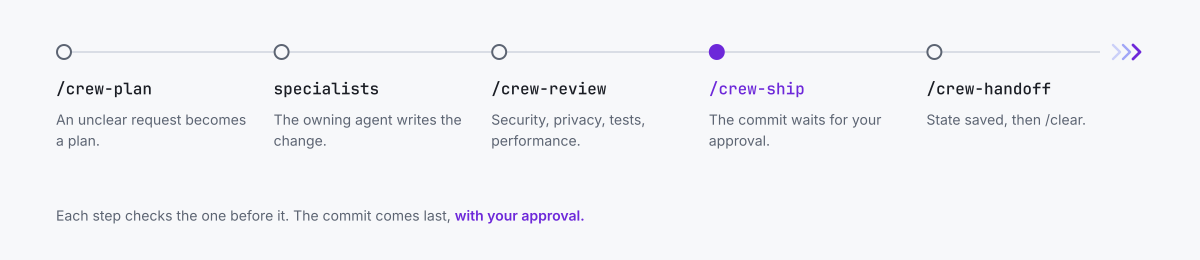
git commitsilently; propose the message, wait for approval.
Prohibitions (absolute — see CLAUDE.md §4)
- No AI trace: no co-author trailer, auto-generation footer, or robot emoji in the subject/body;
words naming an AI assistant, model, or coding tool, and the
.claudename, do not appear in the message. - No vendor name: the third-party template/skeleton name and any "vendor copy / cleanup" disclosure are not written in the message (§4.2).
- Human, natural language: the message is natural, technical, and in the project's established language (English by default for open source).
- Approval: commit only when the user says "commit"; "done" is not approval (§4.4).
- Destructive: amend / reset / force /
--no-verifyonly on an explicit request; the hook is not skipped (§4.5).