Agent Orchestration
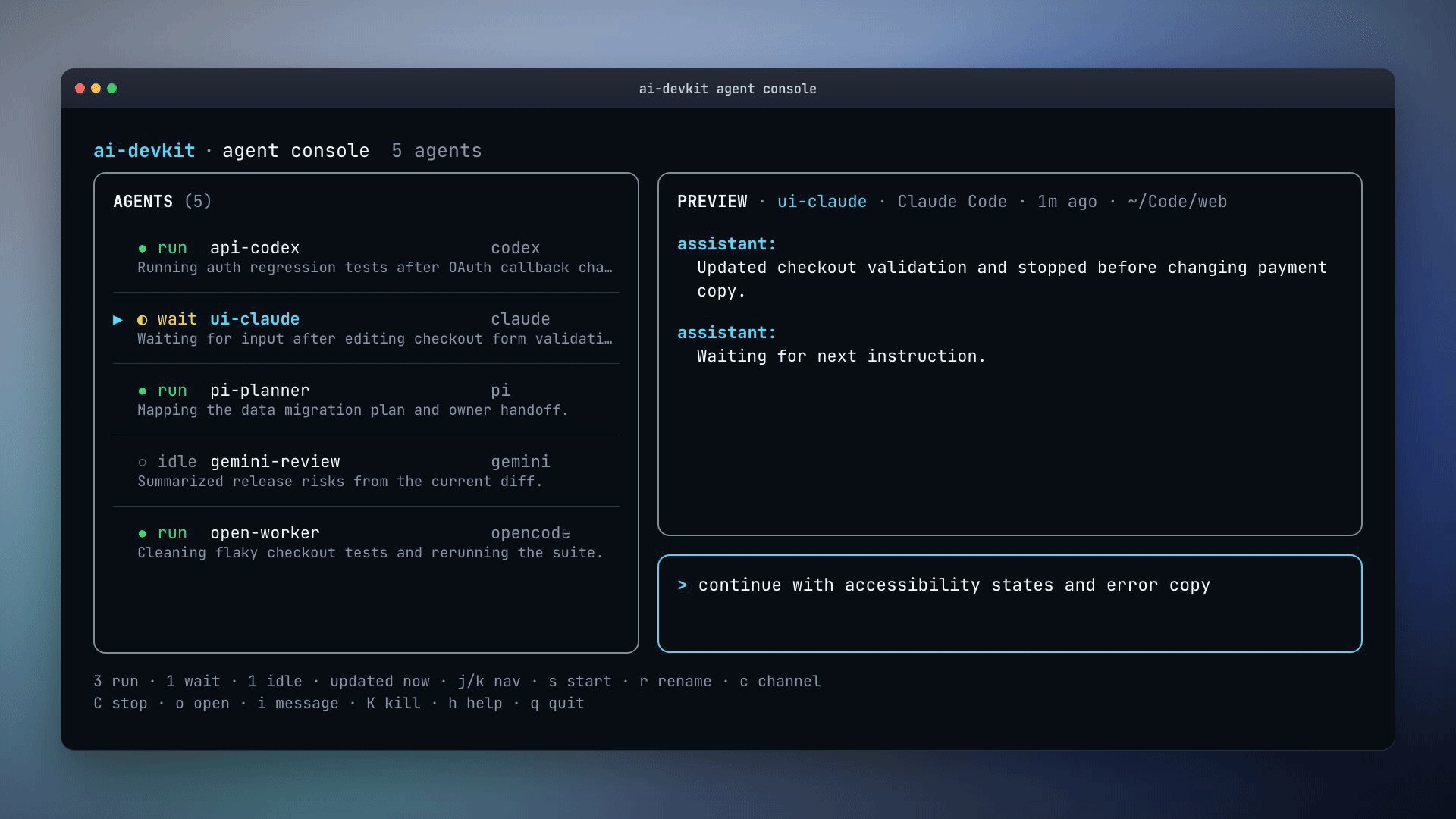
Use only for multi-agent supervision: coordinating dependencies, polling progress, unblocking waiting agents, relaying outputs, resolving conflicts, and verifying completion across agents. For one-off list/detail/send/start/kill work, use $agent-management or $agent-communication.
Use $agent-management for safe agent selection and lifecycle actions. Use $agent-communication for list/detail/send mechanics. Use $verify before accepting any agent's completion claim.
Rules
- Own the loop until assigned work is complete, blocked, or stopped.
- Run
agent list --json before each pass; never assume names/statuses.
- Inspect waiting, idle, unknown, missing, or stale agents before acting.
- Send self-contained instructions and avoid duplicate follow-ups.
- Sequence agents that touch the same files; relay only relevant upstream output.
- Escalate only for repeated failures, unresolved conflicts, product/business decisions, or destructive/shared/production/security-sensitive actions.
Loop
If the goal or agent ownership is unclear, run one scan/detail pass. Ask the user once only if context is still insufficient.
- Scan agents.
- Assess agents needing attention with
detail --tail 10.
- Act: approve, clarify, correct, delegate, relay, verify, or escalate.
- Report one brief status line.
- Sleep 10-60s and repeat.
Completion
Finish when all assigned work is verified, blocked with a clear reason, or stopped by the user. Summarize per-agent outcomes, verification, unresolved issues, and next step.
1---
2name: agent-orchestration
3description: "AI DevKit · Supervise multi-agent workflows over repeated passes: poll progress, unblock waiting agents, coordinate dependencies, relay outputs, resolve conflicts, and verify completion. Use only for ongoing multi-agent coordination, not one-off list/detail/send/start/kill actions."
4metadata:
5 source: https://skillmd.com/skills/codeaholicguy/agent-orchestration
6---
7
8# Agent Orchestration
9
10Use only for multi-agent supervision: coordinating dependencies, polling progress, unblocking waiting agents, relaying outputs, resolving conflicts, and verifying completion across agents. For one-off list/detail/send/start/kill work, use `$agent-management` or `$agent-communication`.
11
12Use `$agent-management` for safe agent selection and lifecycle actions. Use `$agent-communication` for list/detail/send mechanics. Use `$verify` before accepting any agent's completion claim.
13
14## Rules
15
16- Own the loop until assigned work is complete, blocked, or stopped.
17- Run `agent list --json` before each pass; never assume names/statuses.
18- Inspect waiting, idle, unknown, missing, or stale agents before acting.
19- Send self-contained instructions and avoid duplicate follow-ups.
20- Sequence agents that touch the same files; relay only relevant upstream output.
21- Escalate only for repeated failures, unresolved conflicts, product/business decisions, or destructive/shared/production/security-sensitive actions.
22
23## Loop
24
25If the goal or agent ownership is unclear, run one scan/detail pass. Ask the user once only if context is still insufficient.
26
271. Scan agents.
282. Assess agents needing attention with `detail --tail 10`.
293. Act: approve, clarify, correct, delegate, relay, verify, or escalate.
304. Report one brief status line.
315. Sleep 10-60s and repeat.
32
33## Completion
34
35Finish when all assigned work is verified, blocked with a clear reason, or stopped by the user. Summarize per-agent outcomes, verification, unresolved issues, and next step.