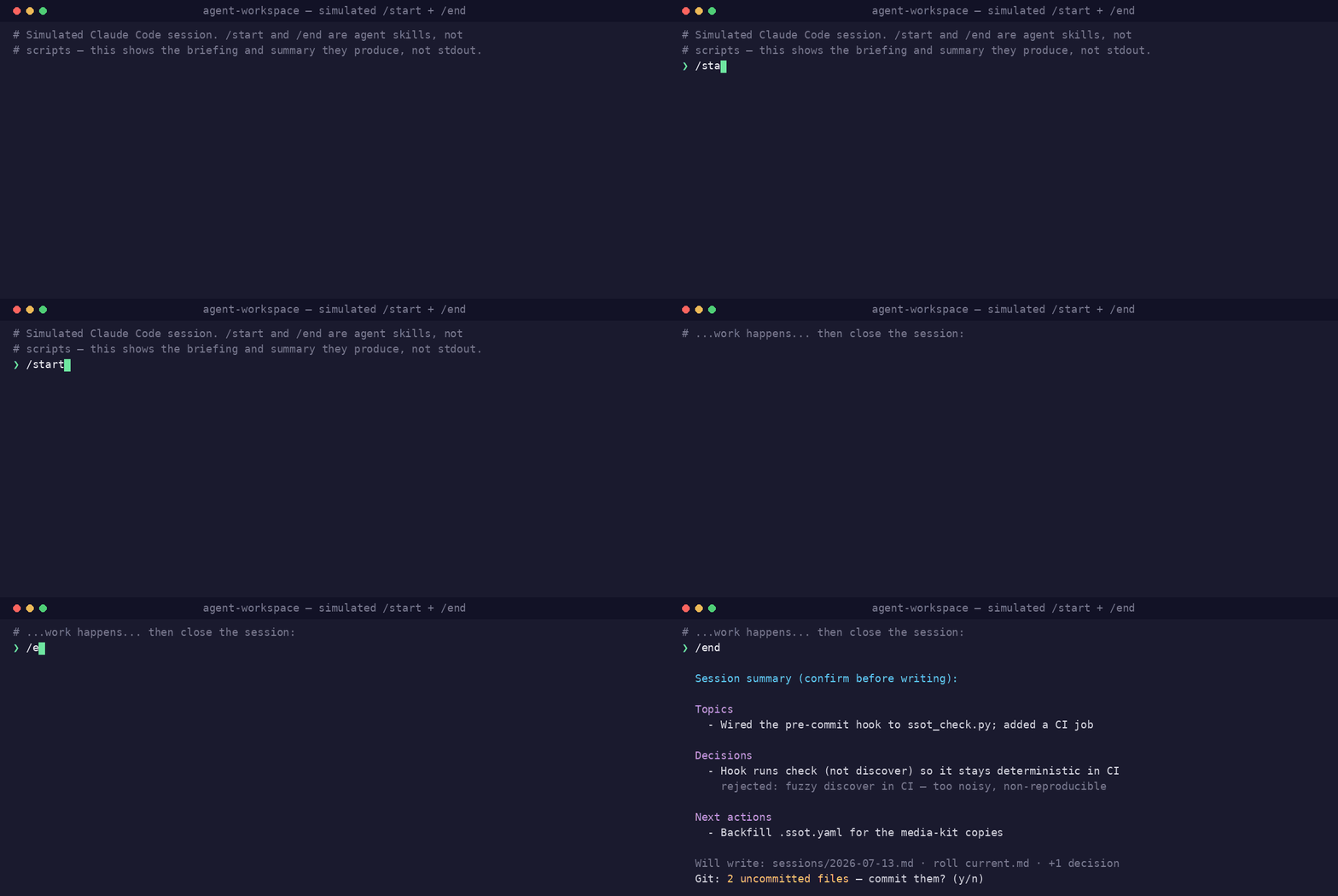
/end — Close Session
Capture the session and leave state ready for the next one: a session log, state updates,
a decision-log append, memory proposals, and a git safety check.
Invocation: user-only (disable-model-invocation: true) — session close is timed by
you, and the flag keeps this skill out of ambient context.
Configuration
Read the optional workspace.yaml at the project root. Below, <state_dir> and
<sessions_dir> are its resolved values; defaults are state/ and sessions/. Full
reference: docs/state-model.md, including the Last Updated chain protocol and the
decision-log schema used in steps 3–4.
Instructions
Auto-extract session summary. Scan the full conversation and extract:
- Topics covered — what was worked on
- Decisions made — anything concluded or chosen, with rationale
- Rejected alternatives — for each meaningful decision, what else was considered and
why it lost. If a bug was fixed, note the wrong theory tried first. If an approach
changed mid-session, capture the pivot. This is the failed-hypothesis record that
keeps a future session from repeating the same wrong starting point.
- State changes — priorities that shifted, threads that opened or closed
- Open threads — unfinished items or things waiting on someone
- Next actions — what needs to happen next session
Present the summary for quick confirmation before writing.
Write session log. Append to <sessions_dir>/{TODAY}.md:
## Session: {TIME}

### Topics
- {topic}

### Decisions
- {decision}

### Open Threads
- {thread}

### Next Actions
- {action}
Update state files:
Always update current.md: add new threads, remove completed items, refresh
timestamps on touched items.
Roll the Last Updated line through current-log.md (chain protocol). Keep
exactly one **Last Updated:** line at the top of current.md, the newest. Never
stack extra lines and never build a single-line "previous-entry" chain — that breaks
the Read tool, breaks grep, and splices parallel-session merges into single-line
conflicts. Instead:
- Read the existing
**Last Updated:** line from current.md.
- Prepend it as its own line at the top of
<state_dir>/current-log.md, directly
under the file header, newest first. Create the file with a
# current.md update log header if it does not exist.
- Replace the
**Last Updated:** line in current.md with today's entry.
One entry per line keeps history append-only and merges line-based.
Update blockers.md if needed: add new dependencies, move resolved blockers to
"Recently Unblocked."
Update weekly-priorities.md if needed: check off completed items. Only touch it
if meaningful progress was made.
Update the decision log. If decisions were made, append to
<state_dir>/decisions.md:
| {TODAY} | {decision} | {context / rationale} | {rejected alternatives} |
Only log decisions future sessions need: source-of-truth changes, strategy pivots, scope
calls, tool or process choices. Skip trivial ones. Fill the rejected alternatives
column when there was a real branch point — what else was considered and why it lost;
leave it blank when there was one obvious option.
Propose auto-memory updates. Beyond state files, scan the session for durable
patterns worth preserving across every conversation in this project. If the agent
auto-loads a project MEMORY.md, anything saved there compounds.
Propose 0–2 additions. Good candidates: environment quirks or tool behaviors confirmed
this session, workflow preferences the user stated ("always X", "never Y"), debugging
fixes that will recur, stable facts about projects or people. Skip: today's work (that's
the session log), anything already in CLAUDE.md or state files, and unverified
single-observation conclusions.
Friction-point check: before proposing, ask — was there a friction point this
session that a memory entry would have prevented? A tool you had to re-learn, an error
you had hit before, a convention you had to re-infer. If yes, write the entry; repeating
a mistake is a system failure, so turn it into a durable rule.
Present proposals inline and wait for approval — never write to memory automatically:
MEMORY PROPOSALS:
- [proposed addition]
(Reply "save" to apply, or skip)
If nothing qualifies, skip silently.
Quick drift check (if parallel sessions ran). In a git repository, run
git log --oneline --all --since="6 hours ago" to catch commits from sessions working
in parallel.
- If any of those commits touched files this session also edited, flag the potential
conflict: "Parallel session also edited [file], check for conflicts." Wait for the
user before fixing anything.
- If none are found, skip silently — do not mention this step.
- This is a fast spot-check, not a full reconcile (see the
reconcile skill for that).
- Outside a git repository, skip this step.
Git safety check (do not skip). In a git repository, run git status and check for
uncommitted or unpushed work:
- Uncommitted changes? Show the files and ask whether to commit.
- Unpushed commits? Show the count and ask whether to push.
- Clean and pushed? Skip silently.
- Outside a git repository, skip this step.
Confirm. Two-line summary: what was logged, and the top open thread or next action.
If memory proposals are awaiting a save/skip reply, note that.
Design principles
- Propose, don't act. State updates are confirmed; memory is never written without a
"save"; commits and pushes need explicit approval.
- Standing rule. Every
/end runs steps 1–8 in order; the chain protocol in step 3 is
how the timestamp always rolls — never append a second Last Updated line as a shortcut.
1---2name: end-33description: Close a work session — log what happened, update state and the decision log, propose durable memory updates, and check for uncommitted or unpushed work.4---56# /end — Close Session78Capture the session and leave state ready for the next one: a session log, state updates,9a decision-log append, memory proposals, and a git safety check.1011**Invocation:** user-only (`disable-model-invocation: true`) — session close is timed by12you, and the flag keeps this skill out of ambient context.1314## Configuration1516Read the optional `workspace.yaml` at the project root. Below, `<state_dir>` and17`<sessions_dir>` are its resolved values; defaults are `state/` and `sessions/`. Full18reference: `docs/state-model.md`, including the `Last Updated` chain protocol and the19decision-log schema used in steps 3–4.2021## Instructions22231. **Auto-extract session summary.** Scan the full conversation and extract:24 - **Topics covered** — what was worked on25 - **Decisions made** — anything concluded or chosen, with rationale26 - **Rejected alternatives** — for each meaningful decision, what else was considered and27 why it lost. If a bug was fixed, note the wrong theory tried first. If an approach28 changed mid-session, capture the pivot. This is the failed-hypothesis record that29 keeps a future session from repeating the same wrong starting point.30 - **State changes** — priorities that shifted, threads that opened or closed31 - **Open threads** — unfinished items or things waiting on someone32 - **Next actions** — what needs to happen next session3334 Present the summary for quick confirmation before writing.35362. **Write session log.** Append to `<sessions_dir>/{TODAY}.md`:37 ```markdown38 ## Session: {TIME}3940 ### Topics41 - {topic}4243 ### Decisions44 - {decision}4546 ### Open Threads47 - {thread}4849 ### Next Actions50 - {action}51 ```52533. **Update state files:**54 - **Always update `current.md`:** add new threads, remove completed items, refresh55 timestamps on touched items.56 - **Roll the `Last Updated` line through `current-log.md` (chain protocol).** Keep57 exactly one `**Last Updated:**` line at the top of `current.md`, the newest. Never58 stack extra lines and never build a single-line "previous-entry" chain — that breaks59 the Read tool, breaks `grep`, and splices parallel-session merges into single-line60 conflicts. Instead:61 1. Read the existing `**Last Updated:**` line from `current.md`.62 2. Prepend it as its own line at the top of `<state_dir>/current-log.md`, directly63 under the file header, newest first. Create the file with a64 `# current.md update log` header if it does not exist.65 3. Replace the `**Last Updated:**` line in `current.md` with today's entry.6667 One entry per line keeps history append-only and merges line-based.68 - **Update `blockers.md` if needed:** add new dependencies, move resolved blockers to69 "Recently Unblocked."70 - **Update `weekly-priorities.md` if needed:** check off completed items. Only touch it71 if meaningful progress was made.72734. **Update the decision log.** If decisions were made, append to74 `<state_dir>/decisions.md`:75 ```markdown76 | {TODAY} | {decision} | {context / rationale} | {rejected alternatives} |77 ```78 Only log decisions future sessions need: source-of-truth changes, strategy pivots, scope79 calls, tool or process choices. Skip trivial ones. Fill the **rejected alternatives**80 column when there was a real branch point — what else was considered and why it lost;81 leave it blank when there was one obvious option.82835. **Propose auto-memory updates.** Beyond state files, scan the session for durable84 patterns worth preserving across *every* conversation in this project. If the agent85 auto-loads a project `MEMORY.md`, anything saved there compounds.8687 Propose 0–2 additions. Good candidates: environment quirks or tool behaviors confirmed88 this session, workflow preferences the user stated ("always X", "never Y"), debugging89 fixes that will recur, stable facts about projects or people. Skip: today's work (that's90 the session log), anything already in `CLAUDE.md` or state files, and unverified91 single-observation conclusions.9293 **Friction-point check:** before proposing, ask — *was there a friction point this94 session that a memory entry would have prevented?* A tool you had to re-learn, an error95 you had hit before, a convention you had to re-infer. If yes, write the entry; repeating96 a mistake is a system failure, so turn it into a durable rule.9798 Present proposals inline and wait for approval — never write to memory automatically:99 ```100 MEMORY PROPOSALS:101 - [proposed addition]102 (Reply "save" to apply, or skip)103 ```104 If nothing qualifies, skip silently.1051066. **Quick drift check (if parallel sessions ran).** In a git repository, run107 `git log --oneline --all --since="6 hours ago"` to catch commits from sessions working108 in parallel.109 - If any of those commits touched files this session also edited, flag the potential110 conflict: "Parallel session also edited [file], check for conflicts." Wait for the111 user before fixing anything.112 - If none are found, skip silently — do not mention this step.113 - This is a fast spot-check, not a full reconcile (see the `reconcile` skill for that).114 - Outside a git repository, skip this step.1151167. **Git safety check (do not skip).** In a git repository, run `git status` and check for117 uncommitted or unpushed work:118 - Uncommitted changes? Show the files and ask whether to commit.119 - Unpushed commits? Show the count and ask whether to push.120 - Clean and pushed? Skip silently.121 - Outside a git repository, skip this step.1221238. **Confirm.** Two-line summary: what was logged, and the top open thread or next action.124 If memory proposals are awaiting a save/skip reply, note that.125126## Design principles127128- **Propose, don't act.** State updates are confirmed; memory is never written without a129 "save"; commits and pushes need explicit approval.130- **Standing rule.** Every `/end` runs steps 1–8 in order; the chain protocol in step 3 is131 how the timestamp always rolls — never append a second `Last Updated` line as a shortcut.