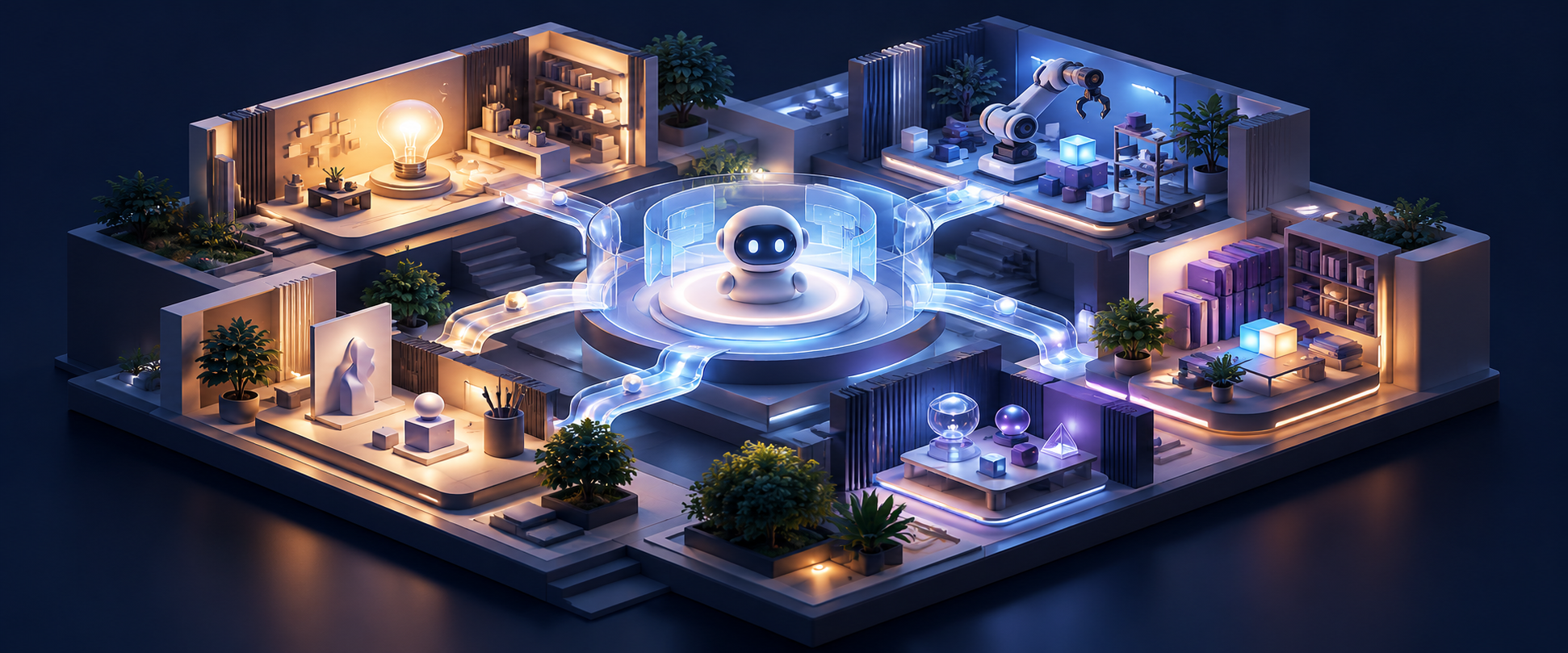
Anatomy
The object is the explanation: invent a recognisable machine whose mechanism
maps onto the idea. Its visual state, readout and caption share one truthful
model. Keep text around the drawing, solids shaded and depth-sorted, and the
subject clearly distinguished.
Progressive discovery
Jev / skill-router selects this skill from its descriptor. Read these resources
only for the current phase; paths in the upstream guide are relative to this
skill's root, not its references directory.
- Before creating geometry, read upstream workflow
for sizing, concept, parts list and build order. Honour the user's scope and
budget. Default to static SVG; add interaction, WebGL or 3D when requested.
- Read craft and kit API when
implementing solids, camera projection and painter's order.
- Choose React integration for React/Next.js or the
framework-free
examples/dial-indicator/build.mjs as the smallest Node
example. Copy the kit/example into the output project before building:
the baked /opt/agentbox/skills/anatomy master copy is read-only.
- Load motion for interaction,
WebGL for shaders, and 3D only for
turning parts. Preserve keyboard access, reduced motion and SVG fallback.
- Use verification for screenshots, close-up inspection,
line ends and depth-order checks. Browser scripts default to local Chromium;
use the estate browser skill / CDP sidecar when local Chromium is unavailable.
Both harnesses can run the Node builders directly.
Included resources
kit/: SVG/TypeScript geometry, drawing, motion, shader and audit primitives.examples/: seven complete framework-free and React examples, including
dial indicator, desk computer, test rig, spot plate, ripple tank, rocket
engine and turning dial. Start with the closest mechanism.scripts/: capture, interaction replay, line checks and 3D fidelity/bench tools.- Walkthrough: a complete worked build.
- Source provenance: upstream archive and local adaptation.
For a smoke build, copy this directory to a writable scratch directory and run
node examples/dial-indicator/build.mjs and again with --light. No package
installation is required for the standalone builder.
1---2name: anatomy3description: >-4 Builds detailed isometric SVG figures that explain a technical idea as a5 working physical object, with solid parts, truthful readouts and optional6 interaction, WebGL or 3D. Use for mechanical technical illustrations,7 algorithm explainers, interactive instruments and crafted figures for docs,8 articles or web pages. Not for architecture topology (fossflow), Mermaid9 corpora (diagrams-as-code), general editorial diagrams (diagram-design),10 or explaining a whole repository (explainer).11license: MIT12compatibility: "Claude Code and Codex; Node builds the bundled geometry kit without npm dependencies. Browser checks need a reachable browser or local Chromium."13metadata:14 source: https://skillmd.com/skills/dreamlab-ai/anatomy15---1617# Anatomy1819The object is the explanation: invent a recognisable machine whose mechanism20maps onto the idea. Its visual state, readout and caption share one truthful21model. Keep text around the drawing, solids shaded and depth-sorted, and the22subject clearly distinguished.2324## Progressive discovery2526Jev / skill-router selects this skill from its descriptor. Read these resources27only for the current phase; paths in the upstream guide are relative to this28skill's root, not its references directory.29301. Before creating geometry, read [upstream workflow](references/upstream-skill.md)31 for sizing, concept, parts list and build order. Honour the user's scope and32 budget. Default to static SVG; add interaction, WebGL or 3D when requested.332. Read [craft](references/craft.md) and [kit API](references/kit.md) when34 implementing solids, camera projection and painter's order.353. Choose [React integration](references/react.md) for React/Next.js or the36 framework-free `examples/dial-indicator/build.mjs` as the smallest Node37 example. Copy the kit/example into the output project before building:38 the baked `/opt/agentbox/skills/anatomy` master copy is read-only.394. Load [motion](references/motion.md) for interaction,40 [WebGL](references/webgl.md) for shaders, and [3D](references/3d.md) only for41 turning parts. Preserve keyboard access, reduced motion and SVG fallback.425. Use [verification](references/verify.md) for screenshots, close-up inspection,43 line ends and depth-order checks. Browser scripts default to local Chromium;44 use the estate browser skill / CDP sidecar when local Chromium is unavailable.45 Both harnesses can run the Node builders directly.4647## Included resources4849- `kit/`: SVG/TypeScript geometry, drawing, motion, shader and audit primitives.50- `examples/`: seven complete framework-free and React examples, including51 dial indicator, desk computer, test rig, spot plate, ripple tank, rocket52 engine and turning dial. Start with the closest mechanism.53- `scripts/`: capture, interaction replay, line checks and 3D fidelity/bench tools.54- [Walkthrough](references/walkthrough.md): a complete worked build.55- [Source provenance](references/provenance.md): upstream archive and local adaptation.5657For a smoke build, copy this directory to a writable scratch directory and run58`node examples/dial-indicator/build.mjs` and again with `--light`. No package59installation is required for the standalone builder.