
Scripts and Automation
Inspect the repository before naming or running an automation target. The
commands and target families below define the intended automation contract;
they do not assert that a Makefile, workflow, release configuration, or named
target already exists. When automation is absent, use the direct Go command or
add the smallest requested wrapper.
Select direct development commands
Use the module's declared Go toolchain and prefer narrow commands while editing:
gofmt -w <changed-go-files>
go test ./pkg/<owner>
go test ./...
go test -race ./...
go vet ./...
go build ./...
Use a focused -run expression for one test and a time-bounded test context
when exercising subprocess cancellation. Do not use go test pipelines that
lose the left-hand exit status.
Cross-build the CLI for each supported target without running the foreign binary. At minimum, cover Linux, Darwin, and Windows on both amd64 and arm64; retain any documented compatibility target such as Windows 386. Keep platform-specific runner files behind build constraints and make a failed target explicit instead of silently reducing the matrix.
Use a built tested binary against controlled modules under testdata for
end-to-end verification. Cover a passing fixture, a normal failing test, a
build failure, and coverage/report generation. Keep cancellation and
process-tree assertions in time-bounded Go integration tests on each native
host, including app-level manifest withholding, instead of adding
timing-sensitive shell signal choreography. Store disposable outputs below
t.TempDir, tmp, or an ignored managed directory.
Exercise repeated CPU benchmark occurrences and a benchmark that explicitly
suppresses ns/op with ReportMetric(0, "ns/op"). Assert their normalized
occurrence counts and absence of incompleteness; do not depend on whether
test2json nondeterministically coalesces or splits the benchmark-name prefix
and result writes.
Keep the fixture module buildable with the minimum Go release. Exercise a
Go 1.25 testing.T.Attr test directly and place any testing.T.ArtifactDir
fixture in a go1.26-constrained file. On Go 1.26, run the artifact fixture
with -artifacts and a pre-created -outputdir; verify raw attr/artifacts
records and redacted JSON, HTML, and JUnit projections, and reject clickable
child-provided artifact paths. Gate those flags and Go 1.26 BuildEvent
assertions using the active go env GOVERSION; on Go 1.25, run the remaining
end-to-end contract and print an explicit versioned skip.
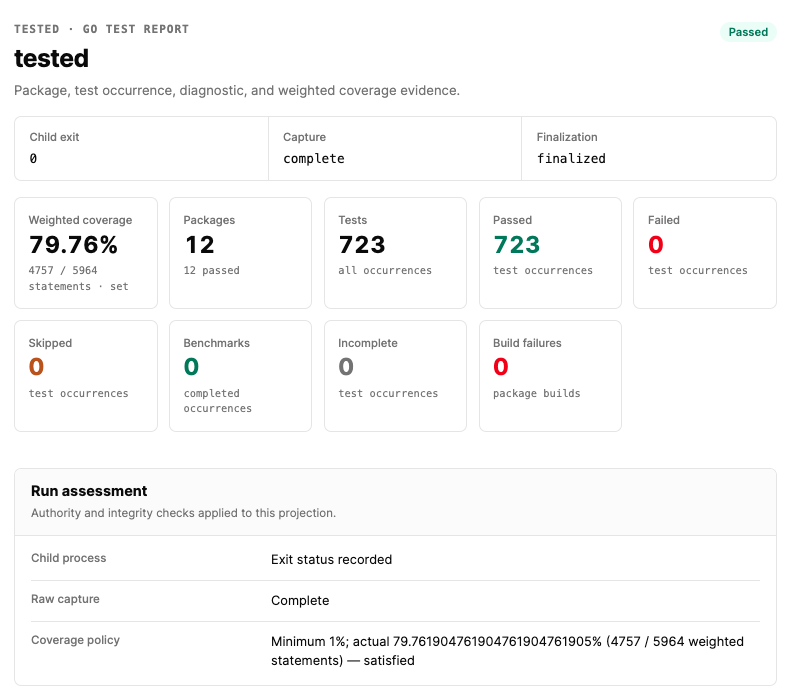
After a coherent fixture run, invoke go run ./scripts/bundlecheck to verify
the exact conditional inventory, private modes on POSIX hosts, manifest order,
security metadata, sizes, and SHA-256 bindings independently from the product
package. Copy deterministic derivative baselines outside .coverage, run
offline tested report, compare exact bytes, and validate the rebuilt bundle
again.
Shape the intended Make surface
When adding or revising a Makefile, keep targets thin, composable, and non-interactive. Prefer these responsibilities:
fmtorfmt-check: format files or verify thatgofmtmakes no diff;test: run direct bootstrap checks, then finish with one canonical self-hosted all-package run that leaves a validated root.coverage;self-test: build the current source, remove only the generated root.coverage, run that binary once with coverage, and validate the exact bundle withscripts/bundlecheck;race: run race-enabled tests on a supported host;vet: run Go static checks;build: compile the localtestedexecutable into an ignored build directory;crossbuild: compile the supported OS/architecture matrix;fixturesorreports: run controlled end-to-end fixtures and verify the exact compatibility and derivative artifact set;skills-check: validate skill frontmatter, UI metadata, placeholders, and the complete forward-only route graph without external dependencies;ci: compose formatting verification, tests, vet, race where supported, cross-builds, and fixture verification without changing source;clean: remove only explicit generated roots such asbin,dist, and.coverage;release-check,release-build, andrelease: separate validation, packaging, and externally mutating publication.
Do not hide dependency installation, go mod tidy, license rewrites, version
changes, git staging, commits, tags, or pushes inside ordinary test, build,
or ci targets. Echo enough context to identify a failing stage while
preserving the underlying command status.
Keep direct formatting, vet, unit, race, and shuffled checks authoritative
until they all pass. Only then build and trust the checked-out tested source
for one final -count=1 self-test. Give that run sole ownership of the root
.coverage directory, require coverage to be present, and run
scripts/bundlecheck only after a zero self-test exit so a secondary
validation error cannot mask the child status. Remove the explicit generated
root before the attempt so stale or unmanaged files cannot appear current.
Make coverage reuse this canonical sequence rather than launch another root
writer.
Build CI deliberately
When adding CI, make direct Go checks the bootstrap authority before using the new tool to test itself. A suitable job order is:
- check out the repository and install the Go version declared by
go.mod; - restore bounded dependency/build caches without caching report evidence;
- verify formatting, then run
go test ./...andgo vet ./...; - run
go test -race ./...and shuffled repetitions on a supported host; - build the current CLI, use it to test its own module once, and independently
validate the resulting root
.coverageinventory and manifest; - cross-build the CLI for the supported matrix;
- run the built CLI against passing, failing, and build-failing fixtures;
- verify exit precedence, file modes where the platform supports them, manifest checksums, exact artifact names, and deterministic rerendering;
- upload
.coverageonly as a diagnostic artifact, including on fixture failure, with access and retention appropriate for potentially sensitive raw evidence.
In the Go 1.26 conformance job, name the root bundle
tested-go-1.26-coverage-YYYYMMDD-HHMMSS, with tested as the literal
repository prefix and the suffix as the UTC upload timestamp. Produce the name
in an always() Bash step immediately before the final always() upload,
write it to $GITHUB_OUTPUT, and consume that step output as the artifact
name. Upload the complete hidden .coverage/ directory instead of enumerating
its current files so future managed derivatives remain available as diagnostic
evidence.
Add operating systems to the matrix when they exercise distinct process-tree behavior. Do not mark Windows, Darwin, or Linux cancellation supported solely because it cross-compiles; run platform-specific lifecycle tests on each native host. At minimum, run the Windows runner suite on a native Windows CI worker when the product claims Job Object ownership and the Darwin suite on a native macOS worker, while retaining cross-compilation for every documented architecture.
Pin third-party actions and release tooling to reviewed versions. The product
replaces tparse and go-test-report; repository validation must not require
installing either tool unless an explicit compatibility comparison test needs
a pinned reference version.
Manage generated artifacts
Treat these as generated and ignored unless the user explicitly asks to retain them:
bin/
dist/
.coverage/
tmp/
*.test
*.out
*.coverprofile
Review git status --short after automation. Do not keep changes to go.mod,
go.sum, VERSION, license headers, source, or documentation as incidental
test output.
Run cleanup only when requested or when a test-owned temporary directory can be removed safely. Resolve every cleanup target to a specific repository child; never use an empty variable, home directory, workspace root, or unvalidated glob as a recursive target.
Handle dependencies
Prefer the standard library and existing module graph. Run go mod download,
go mod tidy, go get, or go install only when the task requires dependency
or module maintenance and network access is authorized.
After an intentional dependency change, run:
go mod tidy
go mod verify
go test ./...
go test -race ./...
Inspect go.mod and go.sum rather than accepting unrelated upgrades.
Prepare releases
Treat every release action as operator-controlled. Before packaging:
- require a clean intended worktree and the repository's release branch;
- validate
VERSIONas the intended semantic version and confirm the matchingv<VERSION>tag does not already exist; - run the complete CI contract;
- build reproducible named archives or binaries for the supported matrix;
- generate SHA-256 checksums and verify package contents, licenses, version output, and help output;
- record the exact commit, Go version, targets, and build flags without embedding volatile data unless the release contract requires it.
Run a non-publishing GoReleaser snapshot during tagged-release preflight using
the same pinned version and configuration as publication. Require each archive
to include LICENSE, README.md, USER_GUIDE.md, and SECURITY.md; verify
the generated checksum set and execute the native preflight binary's version
and help commands. Stamp the full RFC 3339 .CommitDate, not a date-only
substring, together with .FullCommit.
For the GitHub tag workflow, require the tagged commit to be an ancestor of
origin/main. Verify the exact Linux, Darwin, and Windows amd64/arm64 archive
matrix and match the extracted native binary's first version line to the
snapshot version encoded in its archive name before allowing publication.
Keep local packaging separate from tag creation and remote publication. Never
change VERSION, create a commit or tag, push, publish a release, or upload
artifacts unless the user explicitly requests that external state change.
The operator-controlled make release target follows the repository family
convention without inheriting its unsafe shortcuts. It requires a clean
main, the reviewed versioned 1.0.36 binary, a configured origin, and an
absent next-patch tag before running the complete release-check. It repeats
the clean/tag check after CI, increments only VERSION, creates an ops
commit with the required Before/After/Tests/More info sections, creates the
annotated tag, then atomically pushes only main and that exact tag. Do not
replace the narrow atomic push with git push --tags, and do not invoke the
state-changing target during validation; use a dry run or an isolated local
repository and local bare remote.
Completion evidence
Report the exact commands run, host/matrix coverage, pass or failure results, and generated paths. If a documented target is only proposed or not present, say so explicitly and provide the direct command used instead.