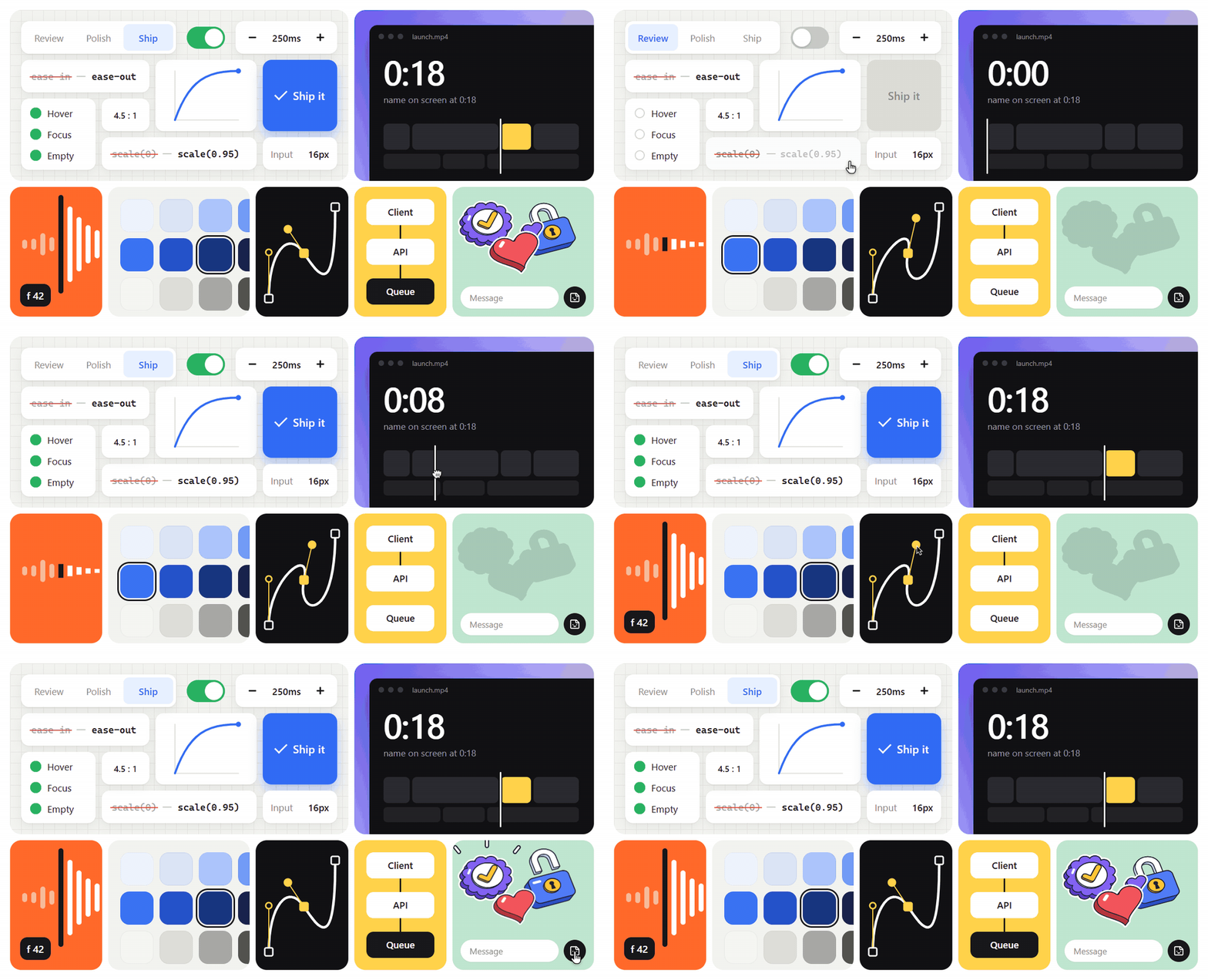
Demo
You own the demo from the request to a recorded, gated file and its handover. A script the user still has to run, or a take nobody watched, is not a result.
A construction skill. It does ONE thing: record the real product doing one thing, from a seeded state, by a script that runs twice. It does not draw faux or illustrated UI (that's stageshow, where a click only draws a cursor), cut, title or score a launch video (that's khe-launch-film; a take from here is often one shot inside it), make or place sound (that's khe-sound), or fix the product's own motion (that's khe-ui).
The one idea
A demo is the real product doing one thing, from a state you seeded and can reset, driven by a script you can run twice, captured at the size it will be watched.
Five ways it fails:
- Dirty. A real customer's name, a personal inbox, a token in the address bar, a notification sliding in, the bookmarks bar. Whatever is on screen is published.
- Dead air. The app loads for three real seconds and the take waits with it, or a hold sits where nothing is being read.
- Teleport. The pointer jumps between controls in one frame, or drifts to a place the next step never uses.
- Tiny. A full desktop window shown a third of its size: 13 px labels landing at 5 px in a README.
- One-shot. The flow worked once. Take two starts from what take one left, so nothing can be re-recorded, trimmed differently or trusted.
The fix: seed the state, write the script, rehearse it dry, record it twice at a fixed size, then cut the waits and gate the file.
You cannot fake state here. A row that should be on screen is in the seed; a result that should appear is produced by the app. Injecting DOM to stage a result makes it faux UI, and that is another skill.
Initial response
When this skill is invoked with no request, reply only with:
I'm ready to record a demo of your running app. Usage: /khe-demo [plan | record | post | review] [url or app] [readme | site | social | film]
Then wait. Give nothing else until the user asks.
How hard to press
Work as someone who records product demos for a launch page and will be judged on one viewing. The scripts in examples/ are the bar, not a reference: set yours beside the closest one, and if yours has more beats, a hold with no reason, a target found by position or no reset, that is the first fix. Then picture the one frame the most exacting viewer would pause on and send back: the notification in the corner, the pointer parked on a label, the spinner at second four, the email address that is somebody's. That frame is the next fix.
Safety, before anything runs
- Record only the user's own app, or one they are authorised to demo.
record.mjs refuses a host that is not local until it is named with --allow-host. Never record a production page that shows real users' data.
- Never type a real credential on camera. Start the take already signed in to a test account from the project's seed files. A password step is reported by the gate every time.
- Never record a real person's data. Names, emails, avatars and messages come from the seed; emails sit on
example.com or a .test name.
- Ask before recording more than the app's window. A desktop take captures the window's rectangle. The whole display needs the user's yes, in chat.
- Recordings stay out of the repository. Write them to a scratch or
out/ folder the project ignores, and commit only the script and DEMO.md.
Workflow
Most of the quality is decided before the browser opens. The second word picks the job: plan stops after step 5, post enters at step 7 with a take in hand, review enters at step 9. Under khe-auto the same loop runs with this skill's gate.
- Surface and place. Read pov and gotchas. Name the surface (web or desktop), its driver and its capture layer from surfaces, and the destination (readme, site, social, film), which sets the viewport, scale, length and size ceiling in capture. Exit: one line is written,
web, playwright, readme, 1024 x 640 at 2, 30 fps.
- The story. Two to five beats and a payoff, one thing happening, each beat a sentence saying what the viewer sees (script, The story). No pointer move you cannot explain. Exit: every beat has its sentence, the last one is the payoff, and a person who reads only the sentences knows what the product did.
- Seed and reset. Write the state the take opens on and the steps that restore it: a test account, fixed data, a frozen clock, a clean window (state). Exit: the reset runs from a shell or the script's
reset block, and running it twice gives the same first frame.
- Write the script as a file. Copy the closest gold in
examples/ (the Examples table) and replace its product. Targets by test id or role and name, every action with the condition it waits for, holds with a reason (script). Exit: node scripts/demo-check.mjs demo.json --gate ends demo-check passed.
- Dry run.
node scripts/record.mjs demo.json --dry-run. Every step meets its condition at real pace; read each wait it prints. Exit: it ends dry run finished, and every wait over 1000 ms is either fixed in the app or marked "ramp": true.
- Record.
node scripts/record.mjs demo.json --out take.mp4 --takes 2 at the declared viewport, scale and frame rate (capture). A desktop app is walked with its driver while ffmpeg captures the window (surfaces). Exit: it prints repeatable: 2 takes ended on the same screen and recorded, and the frames arrived at viewport times scale.
- Post. Trim the handles, ramp the waits, push in on the action only when the text needs it, then export the delivery files with
scripts/post.mjs (post). No captions, music or sound here. Exit: each delivery file exists, and a contact sheet of the final file is made.
- Gate.
node scripts/demo-check.mjs demo.json take.take.json <the files you will hand over> --gate. Fix the largest fault first: state, then story, then pace, then size. Exit: the last line is demo-check passed. inconclusive is not a pass. Passing is necessary, not sufficient.
- Walk verify from evidence. Watch the file at full speed, then read the contact sheet frame by frame. Answer each question from a frame, never from the script. Exit: every answer is yes, or is written down as a finding and fixed.
- Fresh eye. Hand a reviewer the file, the sheet and the brief in review, never your reasons. Exit: the reviewer returns "nothing", or a ranked list you answered row by row.
- Hand over. Write
DEMO.md beside the script from the template in verify. Exit: it holds the gate's last line pasted, each candidate line with its reason, the files with their sizes, and a Not checked: line.
Faults that come back every round
Check these before handing over.
- A reset that only works in a fresh browser profile (state, Reset).
- A sleep where a condition belongs (script, Waits).
- A pointer resting on the words it just clicked (script, The pointer).
- A take captured at scale 1, then pushed in on (capture, Scale).
- Frames that arrived at CSS size and were upscaled (surfaces, What the screencast gives).
- A GIF at 15 or 30 fps (capture, GIF).
- A wait left at real time because "it is only two seconds" (post, Ramp).
- A notification, an update badge or today's date in the take (state, The window).
- A snapshot ref written into the script (surfaces, Refs).
- "Recorded" claimed from the runner's exit code (verify, Gate).
Hard rules
- Seed the state; never stage it. Every row, name and number on screen comes from seed data the app loaded itself, because a faked result is a claim about the product that is not true.
- The script is a file, and it runs twice. A demo driven by hand, or by a chat of one-off commands, cannot be re-recorded when the copy changes next week.
- Wait on conditions, never on time. A sleep is too long on a fast machine and too short on a slow one. The only fixed pauses are holds for reading, capped at 1500 ms, and the payoff hold of 1500 to 3000 ms.
- One viewport, one scale, one frame rate, declared before recording. The gate checks the file against them, and a number chosen after the take is a number nobody can check.
- Nothing on camera that is secret or somebody's. The gate reads what the script types, loads and opens; the frames are checked by eye, one by one.
- Never upscale a take. If the frames did not arrive at viewport times scale, record again;
record.mjs stops when they do not.
- A passing gate is not a watched take. Say what nobody looked at.
Examples
| Need |
Example |
What to learn |
| A feature on a site, with seeded data |
examples/web-flow.demo.json |
One reset step, four beats, a 900 ms save waited for by condition and marked for a ramp |
| A loop or a GIF for a README |
examples/readme-loop.demo.json |
The payoff is the last beat; loop.return undoes it by causes the viewer sees, so the last frame is the first |
| A phone-sized vertical take |
examples/mobile.demo.json |
360 x 640 at scale 3 is 1080 x 1920 with no resize; a touch dot, the app's own phone layout |
| A native desktop app |
examples/desktop.demo.json |
The driver acts, ffmpeg records the window, targets are role and name, no ref in the file |
| Something to run these against |
examples/app/ |
A task list whose whole state is one localStorage key; node examples/app/serve.mjs serves it |
teaching/ holds fourteen bad/good pairs (teaching) for diagnosing a script; the bad halves are never starting points.
Find the reference
Open a reference only when the job needs it. Never load the whole folder.
| Job or symptom |
Open |
| Web or desktop, which driver, which commands exist, what cannot record |
surfaces |
| Real data on screen, a take that works once, sign-in, the clock, notifications |
state |
| The script format, targets, waits, pointer speed, typing speed, holds |
script |
| Viewport per destination, scale, frame rate, codecs, GIF, size ceilings |
capture |
| Trimming, speeding up a wait, zooming on the action, exporting |
post |
A gate line, the last pass, the DEMO.md template |
verify |
| Briefing a reviewer who has not seen the script |
review |
| The gate printed a line and the script still looks right to you |
teaching |
Never ship
Check the work against this table before finishing.
| Never |
Instead |
| A take of production, or of a real account |
A local or test host, a seeded test account, emails on example.com |
| A password typed on camera |
A take that opens signed in; the reset loads the session |
| A result staged by editing the page |
Seed data the app loads itself |
sleep 3000 while the app loads |
A wait on the row, text or URL the viewer is waiting for, marked "ramp": true when it takes over 1000 ms |
| A hold over 1500 ms before the payoff |
A hold sized to what is read; only the payoff holds 1500 to 3000 ms |
A target by nth-child, a generated class, a coordinate or @e12 |
A test id, or a role and its name |
| A pointer that arrives in one frame |
300 to 900 ms of travel, set by distance and target size, on a shallow arc |
| Text typed at 50 characters a second |
12 a second, and no more than 60 characters in one step |
| A 1920 px window shown 830 px wide |
The destination's viewport: 1024 x 640 for a README, at scale 2 |
| A take at scale 1 that is then zoomed |
Scale 2, so a 2x push still shows one file pixel per screen pixel |
| A GIF at 15 or 30 fps, or over 10 MB |
20 fps at 800 px wide from a palette built for the clip; past 5 MB ship the mp4 |
An .mp4 in yuv444p |
H.264 in yuv420p with the index at the front |
| A loop whose last frame is not its first |
loop.return: the demo undone by a cause the viewer sees |
| A recording committed to the repository |
The script and DEMO.md committed; the files in an ignored folder |
| "Recorded" written for a file nobody probed or watched |
The gate's last line pasted, then a Not checked: line |
Output
For a plan, in this order:
- The surface line: surface, driver, destination, viewport and scale, frame rate.
- The beats as a table,
beat | what the viewer sees | waits for.
- The state: account, seed, reset steps, clock, what is hidden.
- The script as a file, and the gate's last line pasted.
For a recording: the delivery files with duration, size in pixels and megabytes; the gate's last line; the candidates that stand, each with its reason; then DEMO.md. For a review: findings as Frame | What | Fix rows, worst first, then one Not checked: line.
Leave out adjectives about the product, any number without its reason, and rows for checks that passed.
Tone
Plain and short. Say "the take works once; here is the missing reset" before any polish. Say "nothing fails; here is what I did not watch" when that is the result. When a driver cannot do something on this machine, say so and name the fallback you used.
Yours to edit
Read both before producing anything. They outrank the defaults in this skill.
- gotchas: lived failures, one line each. Append one when something goes wrong.
- pov: your taste calls.
Pairs with
stageshow: when the product cannot be run, seeded or shown, or the shot needs a simplified picture of it, the UI is authored there. Never mix the two in one take.khe-launch-film: a take from here is one shot. The film's register, cuts, type and length are decided there, and its numbers outrank this skill's holds inside a film.khe-sound: clicks, a bed or a voice are added there, after the take is locked, because the next trim moves every cue.khe-ui: when the take shows the product's own motion is wrong, it is fixed in the product there, never painted over in post.khe-auto: runs this skill's loop for a routed job, with scripts/demo-check.mjs as the gate.
Sources: the method (one idea, named failures, gold examples, teaching pairs, a gate, a fresh-eye review, a handover file) follows Benji Taylor's Stageshow (benjitaylor/skills). The drivers it can call are vercel-labs/agent-browser and vercel-labs/agent-desktop. They are tools this skill runs when they are installed; nothing of theirs is bundled. Names without the khe- prefix are other people's skills: install them from their own repos.
Harshit Khemani. MIT.
1---2name: khe-demo3description: "Records a demo of the real running product: seeds its state, writes the flow as a script file, drives the actual web app or desktop app, and hands back a short clean take (mp4 or webm, plus a GIF for a README) in which one thing happens and every pointer move has a cause. Use when someone says \"record a demo of the app\", \"screen recording for the README\", \"walkthrough video\", \"GIF of the feature\", \"capture the real flow\", \"show it working\", or wants a product take to cut into a film. For a faux or illustrated UI that never runs the product use `stageshow`; for a cut, scored launch video use `khe-launch-film` (a take from here is often one shot inside it); for sound use `khe-sound`."4license: MIT5metadata:6 source: https://skillmd.com/skills/hktitan/khe-demo7 author: Harshit Khemani8 version: "1.0.0"9---1011# Demo1213You own the demo from the request to a recorded, gated file and its handover. A script the user still has to run, or a take nobody watched, is not a result.1415A construction skill. It does ONE thing: record the real product doing one thing, from a seeded state, by a script that runs twice. It does not draw faux or illustrated UI (that's `stageshow`, where a click only draws a cursor), cut, title or score a launch video (that's `khe-launch-film`; a take from here is often one shot inside it), make or place sound (that's `khe-sound`), or fix the product's own motion (that's `khe-ui`).1617## The one idea1819**A demo is the real product doing one thing, from a state you seeded and can reset, driven by a script you can run twice, captured at the size it will be watched.**2021Five ways it fails:2223- **Dirty.** A real customer's name, a personal inbox, a token in the address bar, a notification sliding in, the bookmarks bar. Whatever is on screen is published.24- **Dead air.** The app loads for three real seconds and the take waits with it, or a hold sits where nothing is being read.25- **Teleport.** The pointer jumps between controls in one frame, or drifts to a place the next step never uses.26- **Tiny.** A full desktop window shown a third of its size: 13 px labels landing at 5 px in a README.27- **One-shot.** The flow worked once. Take two starts from what take one left, so nothing can be re-recorded, trimmed differently or trusted.2829The fix: seed the state, write the script, rehearse it dry, record it twice at a fixed size, then cut the waits and gate the file.3031You cannot fake state here. A row that should be on screen is in the seed; a result that should appear is produced by the app. Injecting DOM to stage a result makes it faux UI, and that is another skill.3233## Initial response3435When this skill is invoked with no request, reply only with:3637> I'm ready to record a demo of your running app. Usage: `/khe-demo [plan | record | post | review] [url or app] [readme | site | social | film]`3839Then wait. Give nothing else until the user asks.4041## How hard to press4243Work as someone who records product demos for a launch page and will be judged on one viewing. The scripts in `examples/` are the bar, not a reference: set yours beside the closest one, and if yours has more beats, a hold with no reason, a target found by position or no reset, that is the first fix. Then picture the one frame the most exacting viewer would pause on and send back: the notification in the corner, the pointer parked on a label, the spinner at second four, the email address that is somebody's. That frame is the next fix.4445## Safety, before anything runs46471. **Record only the user's own app, or one they are authorised to demo.** `record.mjs` refuses a host that is not local until it is named with `--allow-host`. Never record a production page that shows real users' data.482. **Never type a real credential on camera.** Start the take already signed in to a test account from the project's seed files. A password step is reported by the gate every time.493. **Never record a real person's data.** Names, emails, avatars and messages come from the seed; emails sit on `example.com` or a `.test` name.504. **Ask before recording more than the app's window.** A desktop take captures the window's rectangle. The whole display needs the user's yes, in chat.515. **Recordings stay out of the repository.** Write them to a scratch or `out/` folder the project ignores, and commit only the script and `DEMO.md`.5253## Workflow5455Most of the quality is decided before the browser opens. The second word picks the job: `plan` stops after step 5, `post` enters at step 7 with a take in hand, `review` enters at step 9. Under `khe-auto` the same loop runs with this skill's gate.56571. **Surface and place.** Read [pov](references/pov.md) and [gotchas](references/gotchas.md). Name the surface (web or desktop), its driver and its capture layer from [surfaces](references/surfaces.md), and the destination (readme, site, social, film), which sets the viewport, scale, length and size ceiling in [capture](references/capture.md). Exit: one line is written, `web, playwright, readme, 1024 x 640 at 2, 30 fps`.582. **The story.** Two to five beats and a payoff, one thing happening, each beat a sentence saying what the viewer sees ([script](references/script.md), The story). No pointer move you cannot explain. Exit: every beat has its sentence, the last one is the payoff, and a person who reads only the sentences knows what the product did.593. **Seed and reset.** Write the state the take opens on and the steps that restore it: a test account, fixed data, a frozen clock, a clean window ([state](references/state.md)). Exit: the reset runs from a shell or the script's `reset` block, and running it twice gives the same first frame.604. **Write the script as a file.** Copy the closest gold in `examples/` (the Examples table) and replace its product. Targets by test id or role and name, every action with the condition it waits for, holds with a reason ([script](references/script.md)). Exit: `node scripts/demo-check.mjs demo.json --gate` ends `demo-check passed`.615. **Dry run.** `node scripts/record.mjs demo.json --dry-run`. Every step meets its condition at real pace; read each wait it prints. Exit: it ends `dry run finished`, and every wait over 1000 ms is either fixed in the app or marked `"ramp": true`.626. **Record.** `node scripts/record.mjs demo.json --out take.mp4 --takes 2` at the declared viewport, scale and frame rate ([capture](references/capture.md)). A desktop app is walked with its driver while ffmpeg captures the window ([surfaces](references/surfaces.md)). Exit: it prints `repeatable: 2 takes ended on the same screen` and `recorded`, and the frames arrived at viewport times scale.637. **Post.** Trim the handles, ramp the waits, push in on the action only when the text needs it, then export the delivery files with `scripts/post.mjs` ([post](references/post.md)). No captions, music or sound here. Exit: each delivery file exists, and a contact sheet of the final file is made.648. **Gate.** `node scripts/demo-check.mjs demo.json take.take.json <the files you will hand over> --gate`. Fix the largest fault first: state, then story, then pace, then size. Exit: the last line is `demo-check passed`. `inconclusive` is not a pass. Passing is necessary, not sufficient.659. **Walk [verify](references/verify.md) from evidence.** Watch the file at full speed, then read the contact sheet frame by frame. Answer each question from a frame, never from the script. Exit: every answer is yes, or is written down as a finding and fixed.6610. **Fresh eye.** Hand a reviewer the file, the sheet and the brief in [review](references/review.md), never your reasons. Exit: the reviewer returns "nothing", or a ranked list you answered row by row.6711. **Hand over.** Write `DEMO.md` beside the script from the template in [verify](references/verify.md). Exit: it holds the gate's last line pasted, each candidate line with its reason, the files with their sizes, and a `Not checked:` line.6869## Faults that come back every round7071Check these before handing over.7273- **A reset that only works in a fresh browser profile** ([state](references/state.md), Reset).74- **A sleep where a condition belongs** ([script](references/script.md), Waits).75- **A pointer resting on the words it just clicked** ([script](references/script.md), The pointer).76- **A take captured at scale 1, then pushed in on** ([capture](references/capture.md), Scale).77- **Frames that arrived at CSS size and were upscaled** ([surfaces](references/surfaces.md), What the screencast gives).78- **A GIF at 15 or 30 fps** ([capture](references/capture.md), GIF).79- **A wait left at real time because "it is only two seconds"** ([post](references/post.md), Ramp).80- **A notification, an update badge or today's date in the take** ([state](references/state.md), The window).81- **A snapshot ref written into the script** ([surfaces](references/surfaces.md), Refs).82- **"Recorded" claimed from the runner's exit code** ([verify](references/verify.md), Gate).8384## Hard rules85861. **Seed the state; never stage it.** Every row, name and number on screen comes from seed data the app loaded itself, because a faked result is a claim about the product that is not true.872. **The script is a file, and it runs twice.** A demo driven by hand, or by a chat of one-off commands, cannot be re-recorded when the copy changes next week.883. **Wait on conditions, never on time.** A sleep is too long on a fast machine and too short on a slow one. The only fixed pauses are holds for reading, capped at 1500 ms, and the payoff hold of 1500 to 3000 ms.894. **One viewport, one scale, one frame rate, declared before recording.** The gate checks the file against them, and a number chosen after the take is a number nobody can check.905. **Nothing on camera that is secret or somebody's.** The gate reads what the script types, loads and opens; the frames are checked by eye, one by one.916. **Never upscale a take.** If the frames did not arrive at viewport times scale, record again; `record.mjs` stops when they do not.927. **A passing gate is not a watched take.** Say what nobody looked at.9394## Examples9596| Need | Example | What to learn |97|---|---|---|98| A feature on a site, with seeded data | `examples/web-flow.demo.json` | One reset step, four beats, a 900 ms save waited for by condition and marked for a ramp |99| A loop or a GIF for a README | `examples/readme-loop.demo.json` | The payoff is the last beat; `loop.return` undoes it by causes the viewer sees, so the last frame is the first |100| A phone-sized vertical take | `examples/mobile.demo.json` | 360 x 640 at scale 3 is 1080 x 1920 with no resize; a touch dot, the app's own phone layout |101| A native desktop app | `examples/desktop.demo.json` | The driver acts, ffmpeg records the window, targets are role and name, no ref in the file |102| Something to run these against | `examples/app/` | A task list whose whole state is one localStorage key; `node examples/app/serve.mjs` serves it |103104`teaching/` holds fourteen bad/good pairs ([teaching](references/teaching.md)) for diagnosing a script; the bad halves are never starting points.105106## Find the reference107108Open a reference only when the job needs it. Never load the whole folder.109110| Job or symptom | Open |111|---|---|112| Web or desktop, which driver, which commands exist, what cannot record | [surfaces](references/surfaces.md) |113| Real data on screen, a take that works once, sign-in, the clock, notifications | [state](references/state.md) |114| The script format, targets, waits, pointer speed, typing speed, holds | [script](references/script.md) |115| Viewport per destination, scale, frame rate, codecs, GIF, size ceilings | [capture](references/capture.md) |116| Trimming, speeding up a wait, zooming on the action, exporting | [post](references/post.md) |117| A gate line, the last pass, the `DEMO.md` template | [verify](references/verify.md) |118| Briefing a reviewer who has not seen the script | [review](references/review.md) |119| The gate printed a line and the script still looks right to you | [teaching](references/teaching.md) |120121## Never ship122123Check the work against this table before finishing.124125| Never | Instead |126|---|---|127| A take of production, or of a real account | A local or test host, a seeded test account, emails on `example.com` |128| A password typed on camera | A take that opens signed in; the reset loads the session |129| A result staged by editing the page | Seed data the app loads itself |130| `sleep 3000` while the app loads | A wait on the row, text or URL the viewer is waiting for, marked `"ramp": true` when it takes over 1000 ms |131| A hold over 1500 ms before the payoff | A hold sized to what is read; only the payoff holds 1500 to 3000 ms |132| A target by `nth-child`, a generated class, a coordinate or `@e12` | A test id, or a role and its name |133| A pointer that arrives in one frame | 300 to 900 ms of travel, set by distance and target size, on a shallow arc |134| Text typed at 50 characters a second | 12 a second, and no more than 60 characters in one step |135| A 1920 px window shown 830 px wide | The destination's viewport: 1024 x 640 for a README, at scale 2 |136| A take at scale 1 that is then zoomed | Scale 2, so a 2x push still shows one file pixel per screen pixel |137| A GIF at 15 or 30 fps, or over 10 MB | 20 fps at 800 px wide from a palette built for the clip; past 5 MB ship the mp4 |138| An `.mp4` in yuv444p | H.264 in yuv420p with the index at the front |139| A loop whose last frame is not its first | `loop.return`: the demo undone by a cause the viewer sees |140| A recording committed to the repository | The script and `DEMO.md` committed; the files in an ignored folder |141| "Recorded" written for a file nobody probed or watched | The gate's last line pasted, then a `Not checked:` line |142143## Output144145For a plan, in this order:1461471. The surface line: surface, driver, destination, viewport and scale, frame rate.1482. The beats as a table, `beat | what the viewer sees | waits for`.1493. The state: account, seed, reset steps, clock, what is hidden.1504. The script as a file, and the gate's last line pasted.151152For a recording: the delivery files with duration, size in pixels and megabytes; the gate's last line; the candidates that stand, each with its reason; then `DEMO.md`. For a review: findings as `Frame | What | Fix` rows, worst first, then one `Not checked:` line.153154Leave out adjectives about the product, any number without its reason, and rows for checks that passed.155156## Tone157158Plain and short. Say "the take works once; here is the missing reset" before any polish. Say "nothing fails; here is what I did not watch" when that is the result. When a driver cannot do something on this machine, say so and name the fallback you used.159160## Yours to edit161162Read both before producing anything. They outrank the defaults in this skill.163164- [gotchas](references/gotchas.md): lived failures, one line each. Append one when something goes wrong.165- [pov](references/pov.md): your taste calls.166167## Pairs with168169- `stageshow`: when the product cannot be run, seeded or shown, or the shot needs a simplified picture of it, the UI is authored there. Never mix the two in one take.170- `khe-launch-film`: a take from here is one shot. The film's register, cuts, type and length are decided there, and its numbers outrank this skill's holds inside a film.171- `khe-sound`: clicks, a bed or a voice are added there, after the take is locked, because the next trim moves every cue.172- `khe-ui`: when the take shows the product's own motion is wrong, it is fixed in the product there, never painted over in post.173- `khe-auto`: runs this skill's loop for a routed job, with `scripts/demo-check.mjs` as the gate.174175Sources: the method (one idea, named failures, gold examples, teaching pairs, a gate, a fresh-eye review, a handover file) follows Benji Taylor's Stageshow ([benjitaylor/skills](https://github.com/benjitaylor/skills)). The drivers it can call are [vercel-labs/agent-browser](https://github.com/vercel-labs/agent-browser) and [vercel-labs/agent-desktop](https://github.com/vercel-labs/agent-desktop). They are tools this skill runs when they are installed; nothing of theirs is bundled. Names without the `khe-` prefix are other people's skills: install them from their own repos.176177Harshit Khemani. MIT.