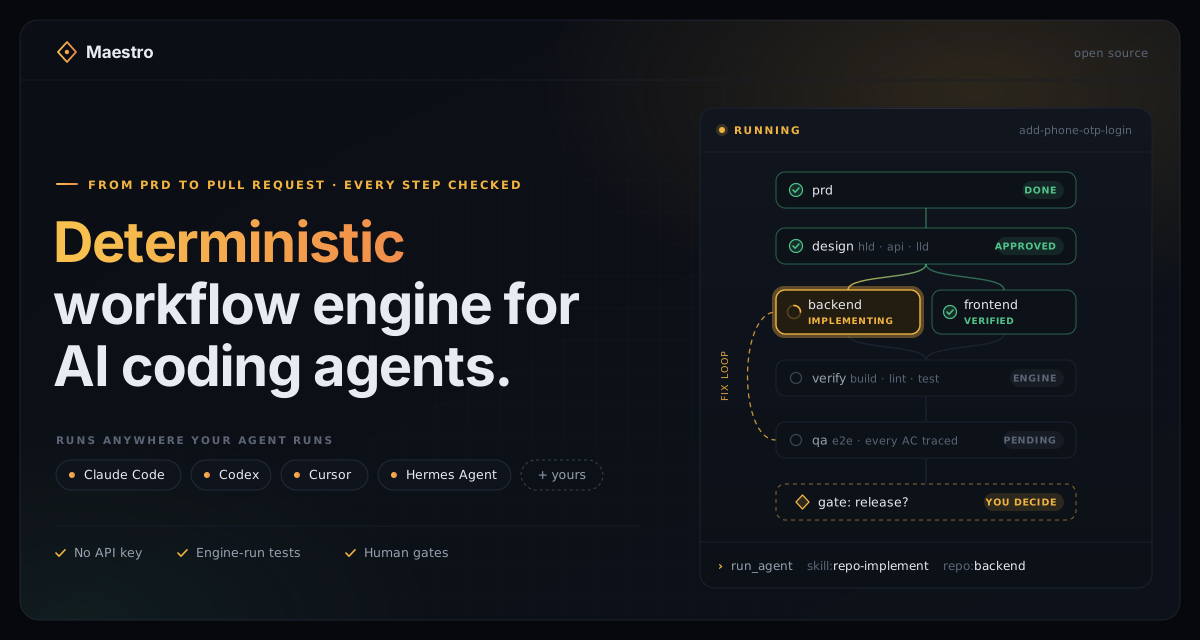
build-knowledge — build the codebase knowledge base from the code
Read the existing code and write a durable knowledge base under docs/: a top-level
architecture.md, and per domain a functional doc (business rules, states, terms) and a
technical doc (invariants, change scenarios, failure behaviour, gotchas). Future agents read
these before planning or changing anything, so they hold what the code cannot tell them cheaply.
Run once per workspace; re-runnable (refresh, don't duplicate).
Inputs
Your instruction names the docs root, the code surface to read (the codebase/ repos or the
single repo, their AGENTS.md/CLAUDE.md/.cursor/rules, existing docs/), and, when one was
extracted, a workspace inventory of endpoints, calls, events, jobs, tables and config.
Standalone with no paths given? Write to docs/ and tell the user.
Format
Every file follows docs-format.md exactly: front-matter, IDs, anchors,
headings, table columns and budgets. The steps below say what to write; the format file says
how it must look. A checker enforces it; when your instruction includes its report, fix exactly
what it names.
What you write, and what you never write
- Write only judgement: purpose and actors, business rules with their edge cases, states and
flows, failure and concurrency behaviour, gotchas, known gaps, owned unknowns.
- Never edit the team's rules. Invariants and change scenarios belong to the project's
people:
## Invariants and consistency and ## Change scenarios in a technical doc,
## Platform-wide invariants in the architecture, and docs/impact/side-effects.yaml. Leave
them exactly as they are (a new doc's say None.). What you find goes under
## Proposed rules and scenarios, without an ID, for the team to accept. The engine restores
any change to the team's content and sends its check report back to you.
- Never write what the code already lists: endpoints, events, jobs, tables, config keys,
calls between repos, directory listings, build commands. A tool generates those into
docs/_generated/ and the Cross-repo connections block; refer to them, never copy them.
- Never edit generated output: anything under
docs/_generated/ or docs/_index/, any
generated: block, verified_at, and the codebase-map marker line.
- Never invent an owner, reviewer, incident, ticket or number. When the code does not settle
a fact, write an owned unknown:
Unknown. (ask: <who>, since <today>).
Method
- Survey the code. Per repo: entry points, flows, datastores, house style. Read each repo's
AGENTS.md, CLAUDE.md or Cursor rules first, applying the instruction files that exist for
the active host. Use the workspace inventory to see every endpoint, call, event, job and table
without grepping for them.
- Identify the domains: the bounded contexts the code is organised around, in kebab-case.
Give each a short capital
id_prefix (e.g. PL for payment-links) and its code_roots.
- Per domain, write two files in the format:
docs/functional/<domain>.md: purpose and actors; glossary; business rules (BR), each
with its edge and source; states and flows; open questions.docs/technical/<domain>.md: failure, concurrency and idempotency; gotchas; known gaps;
and the proposals: each invariant you find (what must always hold, the anchor that enforces
it, the test that proves it) and each change scenario (changing this anchor also affects
that). Leave the team's sections as they are and the Cross-repo connections section
holding only its generated block markers.
Read the code that enforces a rule before writing or proposing it. A rule you cannot point at
code for is either an owned unknown or not a rule.
- Write
docs/architecture.md: system context and repos, the Domain map (a row per domain
linking both files), cross-repo flows and contracts, conventions and boundaries, shared
glossary; platform-wide invariants you find are proposals. Within budget.
- Refresh = keep IDs stable. Update business-rule rows in place. A new rule takes the next
free number (
python3 .maestro/engine/living_docs.py next <PREFIX>). Never renumber or reuse
an ID; a rule that no longer holds keeps its row as Retired YYYY-MM-DD: <why>. When changed
code breaks one of the team's invariants or scenarios, propose the fix; never edit theirs.
- Seed cross-cutting review lessons (optional). For recurring standards/pitfalls that
belong to the corroborated-lesson store (not domain docs), also write an authoritative
drop to the memory incoming path named in your instruction, as JSON:
{"slug": "bootstrap", "lessons": [{"domain": "backend-review", "key": "<kebab>", "text": "...", "authoritative": true}]}. The engine renders these; you do not.
Per-repo codebase map (the HLD's primary grounding)
For EACH repo — in an umbrella workspace, each repo under codebase/; single repo, the repo
itself — write docs/codebase-maps/<name>.md (map_path in the plan below gives each one) in
the shape docs-format.md gives: entry points and key modules; how the repo is built, tested and
run; the primary flows and every distinct execution mode each runs in and what selects it; the
data model, APIs, auth and error conventions — each pointed at as a path · symbol anchor, never
a line number.
Run python3 .maestro/engine/codebase_scan.py plan first to see which repos to map and their
scope — at bootstrap every repo is full (write the whole map); on a refresh a repo is
incremental (update only the areas its changed_files touch) or current (skip). Do not
write or edit the <!-- maestro-codebase-map commit=… --> marker line — the engine stamps the
commit after you write, and that recorded commit is what makes the next refresh incremental.
The maps are committed with the rest of docs/.
Standards
- Document what the code actually does today, not aspirations. A wrong doc is worse than
a missing one; a short doc of true facts beats a long one.
- Every row starts with its subject and reads on its own.
- Re-run = refresh: update existing files in place; add files for new domains; keep human edits.
Safety
- Read-only against application code; write only the written docs (
docs/architecture.md,
docs/functional/, docs/technical/, docs/codebase-maps/) and the optional memory incoming
drop named in your instruction. Never edit application code or generated files.
Output contract
Return domains_written (count of domains documented), architecture_path (the
architecture.md you wrote), and summary (one line).
1---2name: build-knowledge3description: Scan the codebase and build the living-docs knowledge base (architecture.md, plus functional and technical docs per domain with rule, invariant and change-scenario IDs), the per-repo codebase maps, and seed cross-cutting review lessons. Front door for /build-knowledge.4allowed-tools: Read, Grep, Glob, Bash, Write5tags: [maestro, memory, bootstrap, docs]6metadata:7 source: https://skillmd.com/skills/keyvaluesoftwaresystems/build-knowledge8---910# build-knowledge — build the codebase knowledge base from the code1112Read the existing code and write a durable knowledge base under `docs/`: a top-level13**architecture.md**, and per domain a **functional** doc (business rules, states, terms) and a14**technical** doc (invariants, change scenarios, failure behaviour, gotchas). Future agents read15these before planning or changing anything, so they hold what the code cannot tell them cheaply.16Run once per workspace; re-runnable (refresh, don't duplicate).1718## Inputs19Your instruction names the docs root, the code surface to read (the `codebase/` repos or the20single repo, their `AGENTS.md`/`CLAUDE.md`/`.cursor/rules`, existing `docs/`), and, when one was21extracted, a workspace inventory of endpoints, calls, events, jobs, tables and config.22Standalone with no paths given? Write to `docs/` and tell the user.2324## Format25Every file follows **[docs-format.md](docs-format.md)** exactly: front-matter, IDs, anchors,26headings, table columns and budgets. The steps below say what to write; the format file says27how it must look. A checker enforces it; when your instruction includes its report, fix exactly28what it names.2930## What you write, and what you never write31- **Write only judgement**: purpose and actors, business rules with their edge cases, states and32 flows, failure and concurrency behaviour, gotchas, known gaps, owned unknowns.33- **Never edit the team's rules.** Invariants and change scenarios belong to the project's34 people: `## Invariants and consistency` and `## Change scenarios` in a technical doc,35 `## Platform-wide invariants` in the architecture, and `docs/impact/side-effects.yaml`. Leave36 them exactly as they are (a new doc's say `None.`). What you find goes under37 `## Proposed rules and scenarios`, without an ID, for the team to accept. The engine restores38 any change to the team's content and sends its check report back to you.39- **Never write what the code already lists**: endpoints, events, jobs, tables, config keys,40 calls between repos, directory listings, build commands. A tool generates those into41 `docs/_generated/` and the `Cross-repo connections` block; refer to them, never copy them.42- **Never edit generated output**: anything under `docs/_generated/` or `docs/_index/`, any43 `generated:` block, `verified_at`, and the codebase-map marker line.44- **Never invent** an owner, reviewer, incident, ticket or number. When the code does not settle45 a fact, write an owned unknown: `Unknown. (ask: <who>, since <today>)`.4647## Method481. **Survey the code.** Per repo: entry points, flows, datastores, house style. Read each repo's49 `AGENTS.md`, `CLAUDE.md` or Cursor rules first, applying the instruction files that exist for50 the active host. Use the workspace inventory to see every endpoint, call, event, job and table51 without grepping for them.522. **Identify the domains**: the bounded contexts the code is organised around, in kebab-case.53 Give each a short capital `id_prefix` (e.g. `PL` for `payment-links`) and its `code_roots`.543. **Per domain, write two files** in the format:55 - `docs/functional/<domain>.md`: purpose and actors; glossary; business rules (`BR`), each56 with its edge and source; states and flows; open questions.57 - `docs/technical/<domain>.md`: failure, concurrency and idempotency; gotchas; known gaps;58 and the proposals: each invariant you find (what must always hold, the anchor that enforces59 it, the test that proves it) and each change scenario (changing this anchor also affects60 that). Leave the team's sections as they are and the `Cross-repo connections` section61 holding only its generated block markers.62 Read the code that enforces a rule before writing or proposing it. A rule you cannot point at63 code for is either an owned unknown or not a rule.644. **Write `docs/architecture.md`**: system context and repos, the Domain map (a row per domain65 linking both files), cross-repo flows and contracts, conventions and boundaries, shared66 glossary; platform-wide invariants you find are proposals. Within budget.675. **Refresh = keep IDs stable.** Update business-rule rows in place. A new rule takes the next68 free number (`python3 .maestro/engine/living_docs.py next <PREFIX>`). Never renumber or reuse69 an ID; a rule that no longer holds keeps its row as `Retired YYYY-MM-DD: <why>`. When changed70 code breaks one of the team's invariants or scenarios, propose the fix; never edit theirs.716. **Seed cross-cutting review lessons (optional).** For recurring standards/pitfalls that72 belong to the corroborated-lesson store (not domain docs), also write an authoritative73 drop to the memory incoming path named in your instruction, as JSON:74 `{"slug": "bootstrap", "lessons": [{"domain": "backend-review", "key": "<kebab>",75 "text": "...", "authoritative": true}]}`. The engine renders these; you do not.7677## Per-repo codebase map (the HLD's primary grounding)78For EACH repo — in an umbrella workspace, each repo under `codebase/`; single repo, the repo79itself — write **`docs/codebase-maps/<name>.md`** (`map_path` in the plan below gives each one) in80the shape docs-format.md gives: entry points and key modules; how the repo is built, tested and81run; the primary flows and **every distinct execution mode** each runs in and what selects it; the82data model, APIs, auth and error conventions — each pointed at as a `path · symbol` anchor, never83a line number.8485Run `python3 .maestro/engine/codebase_scan.py plan` first to see which repos to map and their86scope — at bootstrap every repo is `full` (write the whole map); on a refresh a repo is87`incremental` (update only the areas its `changed_files` touch) or `current` (skip). Do **not**88write or edit the `<!-- maestro-codebase-map commit=… -->` marker line — the engine stamps the89commit after you write, and that recorded commit is what makes the next refresh incremental.90The maps are committed with the rest of `docs/`.9192## Standards93- Document what the code **actually does today**, not aspirations. A wrong doc is worse than94 a missing one; a short doc of true facts beats a long one.95- Every row starts with its subject and reads on its own.96- Re-run = refresh: update existing files in place; add files for new domains; keep human edits.9798## Safety99- Read-only against application code; write only the written docs (`docs/architecture.md`,100 `docs/functional/`, `docs/technical/`, `docs/codebase-maps/`) and the optional memory incoming101 drop named in your instruction. Never edit application code or generated files.102103## Output contract104Return `domains_written` (count of domains documented), `architecture_path` (the105architecture.md you wrote), and `summary` (one line).