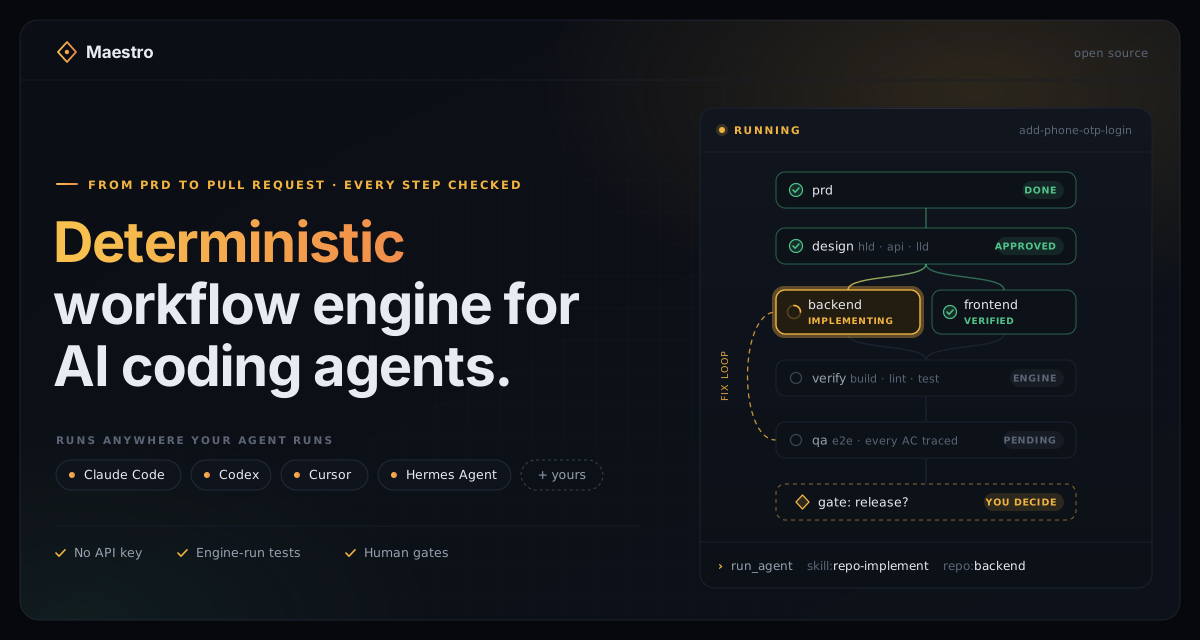
fix-loop
One invocation = one fix attempt. Diagnose the failure, apply the smallest safe fix,
re-run the failing checks, and report. Do NOT loop internally: make one attempt, then
hand the result back — the caller re-invokes while checks still fail and owns the loop
bound, so a run never spins here. Run standalone, the same rule holds.
Safety: never run destructive commands (rm -rf, force-push, DROP/TRUNCATE) or write
prod config/secrets. Nothing auto-blocks this — you are the backstop, and this rule holds
regardless of environment. The escalation triggers below are hard stops. Never weaken or
delete a failing test to make a check pass.
External skill (provision — debugging method)
If the systematic-debugging skill (from the Superpowers pack) is installed, use its
four-phase root-cause method — do not "fix" what you have not
understood. Whatever the method, it must: reproduce the failure, find the root cause,
predict the fix, and confirm. If it is not installed, follow the same discipline in-pack.
The attempt (this invocation)
- Reproduce — quote the exact failing command and its real error output. When your
instructions supply a verification receipt or logs, start from the commands and output
they record instead of guessing which checks failed.
- Diagnose — find the root cause (read the code/stack trace); distinguish a real bug
from a flaky test or an environment problem. State the cause before touching code.
- Smallest fix — edit only files related to that root cause; no broad refactors,
no unrelated "drive-by" changes.
- Re-run the failing check; record the result.
- If green, run the project's other checks (build, lint, full tests) — unless your
instructions say an independent verification or re-run follows this attempt, in which case
skip it. If a new failure appears, report it — the next invocation (a fresh attempt) handles
it; do not chain fixes here.
Classify before you "fix"
- Flaky test — fix the test's determinism (waits/selectors/seeding), not the product,
and never by weakening assertions.
- Environment issue (service down, port, missing dep) — fix the env / report it; not a
code change to force green.
- Real defect — fix the code with a regression test that fails before and passes after.
- Committed secret (a
secrets check failure) — remove the credential from the code and from
the feature branch's commits (amend or rewrite only that unpublished branch), load it from the
project's configuration or secret store instead, and report that the credential must be rotated.
Never allowlist or obfuscate it to pass the scan.
- Spec/contract ambiguity — stop and ask; do not invent behavior.
- Product bug found by a test suite you may not change product code for (a QA run against
frozen, reviewed commits) — do not touch the product. Report it as a product bug with the
repositories to fix, and write the diagnosis where your instructions say: per repository, the
failing case IDs, expected vs actual behaviour, how to reproduce, and the suspected code. The
caller fixes it in implementation and re-runs the suite.
Answering review findings
When your instructions give a reviewer's findings file and a resolutions path, answer every
blocking finding whose status is open or upheld, and write
{"schema_version": 1, "resolutions": [{"id", "resolution", "note"}]}:
fixed — make the smallest fix; the note names what changed;contested — the finding is wrong; the note gives the evidence (the LLD or contract clause, the
code, a test). Never change correct code only to satisfy a wrong finding. A finding the
reviewer already upheld cannot be contested again;escalated — it needs a person's decision (a design or contract change, a trade-off); the note
states the decision exactly.
Write the file on every attempt that has blocking findings, even when all you did was fix
failing checks — answers from an earlier round do not count.
Stop and ask a human if
- a DB migration is required but not approved · the API contract would change ·
auth/permission behavior changes · a dependency upgrade is needed · production config
changes · the same root cause persists from a previous attempt with no new hypothesis ·
multiple valid designs exist · the fix would weaken a test or a security control.
Definition of done (per attempt)
Either: the targeted check (and the full checks, if reached) passes with a root-cause fix (and a
regression test for real defects); or you report the failure honestly — the exact commands,
the root cause (or best hypothesis), files changed, and remaining risk — and let the workflow
decide whether to re-invoke. Escalation is success, not failure.
Output contract
Return root_cause (one line, or the hypothesis), fix_summary (files changed + what
changed), checks_passed, and escalate (true when a hard-stop trigger above was hit). When the
caller asks for them (a suite run against frozen product code), also return product_bug (true
when the product, not the test, is wrong) and bug_repos (the comma-separated repositories to
fix; empty otherwise).
checks_passed MUST be the literal JSON boolean true or false (true only if the targeted
checks actually ran AND passed after your fix) — never a count or status phrase. It is your
own report; a caller may still re-run the checks independently before trusting it.
1---2name: fix-loop3description: Make ONE bounded fix attempt at failing deterministic checks — root-cause first, editing only files related to the failure — then report. Front door for /fix-loop.4allowed-tools: Read, Grep, Glob, Bash, Edit5tags: [sdlc, fix, debug]6metadata:7 source: https://skillmd.com/skills/keyvaluesoftwaresystems/fix-loop8---910# fix-loop1112**One invocation = one fix attempt.** Diagnose the failure, apply the smallest safe fix,13re-run the failing checks, and report. Do **NOT** loop internally: make one attempt, then14hand the result back — the caller re-invokes while checks still fail and owns the loop15bound, so a run never spins here. Run standalone, the same rule holds.1617**Safety:** never run destructive commands (`rm -rf`, force-push, `DROP`/`TRUNCATE`) or write18prod config/secrets. Nothing auto-blocks this — you are the backstop, and this rule holds19regardless of environment. The escalation triggers below are hard stops. **Never weaken or20delete a failing test** to make a check pass.2122## External skill (provision — debugging method)23If the `systematic-debugging` skill (from the Superpowers pack) is installed, use its24four-phase root-cause method — **do not "fix" what you have not25understood.** Whatever the method, it must: reproduce the failure, find the root cause,26predict the fix, and confirm. If it is not installed, follow the same discipline in-pack.2728## The attempt (this invocation)291. **Reproduce** — quote the exact failing command and its real error output. When your30 instructions supply a verification receipt or logs, start from the commands and output31 they record instead of guessing which checks failed.322. **Diagnose** — find the root cause (read the code/stack trace); distinguish a real bug33 from a flaky test or an environment problem. State the cause before touching code.343. **Smallest fix** — edit **only** files related to that root cause; no broad refactors,35 no unrelated "drive-by" changes.364. **Re-run the failing check**; record the result.375. If green, run the project's other checks (build, lint, full tests) — unless your38 instructions say an independent verification or re-run follows this attempt, in which case39 skip it. If a new failure appears, report it — the next invocation (a fresh attempt) handles40 it; do not chain fixes here.4142## Classify before you "fix"43- **Flaky test** — fix the test's determinism (waits/selectors/seeding), not the product,44 and never by weakening assertions.45- **Environment issue** (service down, port, missing dep) — fix the env / report it; not a46 code change to force green.47- **Real defect** — fix the code with a regression test that fails before and passes after.48- **Committed secret** (a `secrets` check failure) — remove the credential from the code and from49 the feature branch's commits (amend or rewrite only that unpublished branch), load it from the50 project's configuration or secret store instead, and report that the credential must be rotated.51 Never allowlist or obfuscate it to pass the scan.52- **Spec/contract ambiguity** — stop and ask; do not invent behavior.53- **Product bug found by a test suite you may not change product code for** (a QA run against54 frozen, reviewed commits) — do not touch the product. Report it as a product bug with the55 repositories to fix, and write the diagnosis where your instructions say: per repository, the56 failing case IDs, expected vs actual behaviour, how to reproduce, and the suspected code. The57 caller fixes it in implementation and re-runs the suite.5859## Answering review findings60When your instructions give a reviewer's findings file and a resolutions path, answer every61blocking finding whose status is `open` or `upheld`, and write62`{"schema_version": 1, "resolutions": [{"id", "resolution", "note"}]}`:63- `fixed` — make the smallest fix; the note names what changed;64- `contested` — the finding is wrong; the note gives the evidence (the LLD or contract clause, the65 code, a test). Never change correct code only to satisfy a wrong finding. A finding the66 reviewer already `upheld` cannot be contested again;67- `escalated` — it needs a person's decision (a design or contract change, a trade-off); the note68 states the decision exactly.69Write the file on every attempt that has blocking findings, even when all you did was fix70failing checks — answers from an earlier round do not count.7172## Stop and ask a human if73- a DB migration is required but not approved · the API contract would change ·74 auth/permission behavior changes · a dependency upgrade is needed · production config75 changes · the same root cause persists from a previous attempt with no new hypothesis ·76 multiple valid designs exist · the fix would weaken a test or a security control.7778## Definition of done (per attempt)79Either: the targeted check (and the full checks, if reached) passes with a root-cause fix (and a80regression test for real defects); or you report the failure honestly — the exact commands,81the root cause (or best hypothesis), files changed, and remaining risk — and let the workflow82decide whether to re-invoke. Escalation is success, not failure.8384## Output contract85Return `root_cause` (one line, or the hypothesis), `fix_summary` (files changed + what86changed), `checks_passed`, and `escalate` (true when a hard-stop trigger above was hit). When the87caller asks for them (a suite run against frozen product code), also return `product_bug` (true88when the product, not the test, is wrong) and `bug_repos` (the comma-separated repositories to89fix; empty otherwise).90`checks_passed` MUST be the literal JSON boolean `true` or `false` (true only if the targeted91checks actually ran AND passed after your fix) — never a count or status phrase. It is your92own report; a caller may still re-run the checks independently before trusting it.