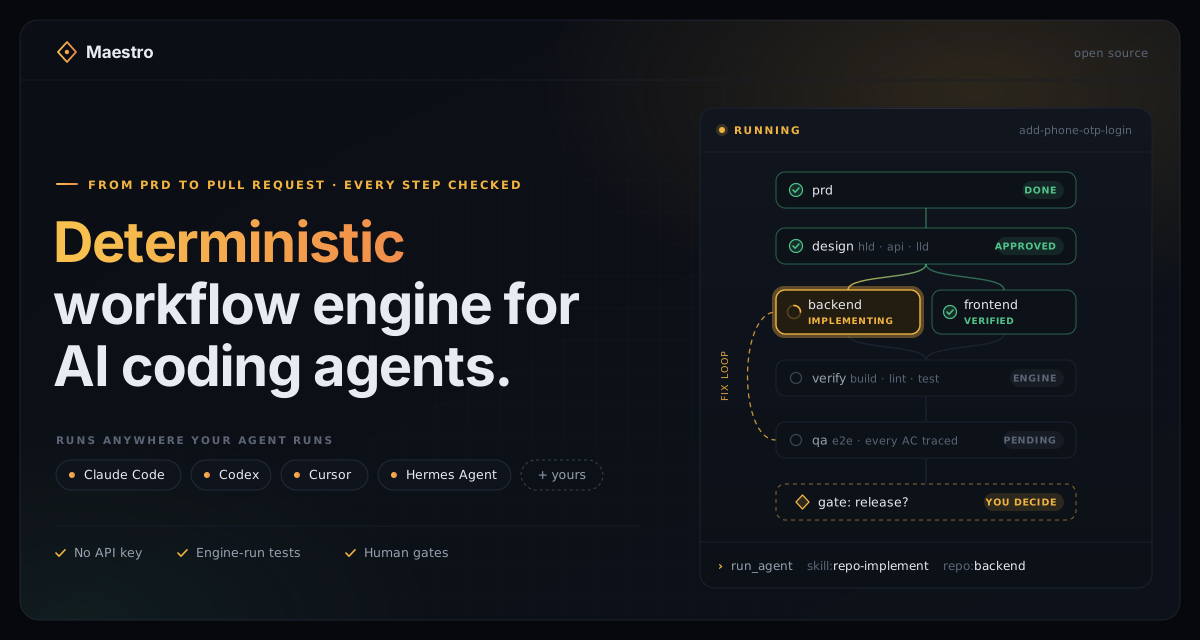
PRD interview
Build shared understanding before prose. This skill runs in the lead agent's context so the
conversation stays warm; never delegate it to a worker. The one exception is discussing a single
question the user is unsure about: that runs in an isolated discussion agent or a side chat, under
this skill's read boundary and conversation standards, so its reading never fills the lead's
context.
Read boundary
Read only paths explicitly supplied by the workflow, requirement files, explicit references,
root AGENTS.md / CLAUDE.md, and maintained summaries under docs/ such as
architecture.md, functional/ and product/. Never inspect application source, search
parent/home/Desktop directories, or widen the scan because a summary is missing. Say what is
unknown and ask.
Modes
The served instruction selects one mode:
- Project context — state what the product/system is and who it serves in at most 3 short
sentences. Do not describe implementation details.
- Feature goal — restate the requested outcome in at most 2 short sentences. Preserve the
user's wording and scope; do not add capabilities.
- Grill queue — read prior confirmed decisions when the supplied file exists. Generate the
next JSON queue at the workflow-supplied artifact path and run the supplied validator. Audit
prior answers against their declared resolution facts before finding new gaps. Use an empty
questions array only when no material ambiguity or contradiction remains.
- Interview turn — collect every question served in the current action through the requested
presentation surface, with its reason, recommendation, alternatives, and a not sure option.
Then discuss each item the human is unsure about or asked about, take any point they raise, and
record the complete round in one batch operation (see Conversation).
Grill method
Ask about the feature, never the document structure. Derive each question from confirmed context,
requirements, references, revision feedback, and earlier answers.
- Resolve one material decision per question. Use a concrete actor, action, state, or failure
scenario instead of broad prompts.
- Explain in one short sentence why the answer changes the product.
- Recommend an answer only when evidence supports it. A recommendation is not confirmed until the
user accepts it.
- When the decision is a genuine choice, add up to two
alternatives, each a short label and the
concrete tradeoff a product owner would weigh. Do not pad a clear decision with straw options.
- Challenge the happy path only through relevant lenses: permissions; lifecycle transitions;
timing and limits; visible conflict/concurrency; cancellation, retry, and recovery; invalid or
stale input; notifications and external effects; privacy and visibility; admin overrides;
migration or compatibility; measurable success; non-goals; and non-functional targets that
would change the design (volume and growth, response time, availability and recovery,
retention and compliance, accessibility) — asked as concrete numbers the human can confirm.
- Skip irrelevant lenses. Ask fewer questions as clarity increases. Never ask every category just
to fill a checklist.
- Never repeat a confirmed decision. Never ask “what should this PRD section say?”
Answer audit
A recorded answer is not automatically a resolved decision.
- Compare every earlier answer with that question's
must_resolve facts. A free-form answer may
settle one fact and leave another open.
- Treat only the stored
answer as confirmed. Do not copy an unanswered part of proposal into a
decision when source is user-answer.
- Read every
source: chosen-alternative and accepted-proposal are confirmed; assumption is
a working answer the user could not verify; deferred is parked and settles nothing;
user-raised is the user's own requirement or concern — reconcile it with the other decisions
and ask a follow-up if it is incomplete. A discussion summary records what was already
explored; build on it instead of re-asking.
- Re-ask a deferred decision only when the PRD cannot be written honestly without it, and then with
a sharper question or options that make it answerable; otherwise leave it parked.
- Compare decisions with each other. If two rules disagree about an actor, state, boundary, limit,
or timing condition, ask one focused reconciliation question.
- Ask a follow-up only for the missing or conflicting fact. Give it a new feature-specific ID so
the original answer remains visible.
- Before returning an empty queue, verify that every material fact is explicit, concrete enough
to test, and internally consistent. Vague values such as “short,” “later,” “fixed timezone,” or
“as needed” require a follow-up when they change implementation or acceptance.
The queue JSON has schema_version: 2, questions, and an audit object. Each question has id,
title, question, why, proposal, and must_resolve: one to four short facts the answer must
make explicit. Optional alternatives holds at most two {label, tradeoff} objects. audit.unresolved and audit.contradictions briefly name the gaps that produced the
queue. Both arrays must be empty when questions is empty. Keep IDs stable and feature-specific;
they are internal and must not appear in the PRD.
Fewest questions. There is no minimum, and an empty queue on the first pass is a normal
result. A question earns its place only when the requirement, references, docs and decision log do not answer it and reasonable answers differ in a way
that changes scope, user-visible behaviour or acceptance. A point with one sensible answer is not a
question: record it under settled when a source states it, otherwise leave it to the PRD
writer. Put every material
gap in one queue rather than spreading it over rounds.
One decision log, no repeats. Your instructions may supply the feature's decision log (every
earlier stage's decisions) and this stage's decisions. Give every question a short kebab-case
topic naming what it decides. Never ask a topic already decided in either; to refine a recorded
answer, ask at most one follow-up with follow_up_of: <that decision's id>. Rephrasing a decided
question under a new id is still a repeat.
Decide from evidence first. Before asking, check the requirement, approved documents, code and
docs. A point they already settle is not a question: record it under the queue's settled array
as {topic, title, decision, source}, where source is the file that settles it
(path, path#section or path:line). The engine records it as an evidence-settled decision.
Conversation
The user may not know an answer. That is a normal outcome, not a failure — help them get there.
- When they are unsure or ask something back, explain what the decision changes for users, why you
recommend what you do, and when an alternative would win. Answer side questions from the
requirement files, references, and maintained summaries; say when those do not cover it.
- If a fact belongs to someone else (legal, ops, a client), say so and offer to record the
recommendation as a working assumption or park the decision.
- Invite the user to raise what you missed. Their points are as binding as your questions.
- Keep turns short and let the user steer; this is a conversation, not a lecture.
Standards
- Do not write or edit
prd.md during this skill.
- Do not silently assume a material product fact: when it is unknown and answers differ, ask.
- State each idea once. Prefer bullets or one short paragraph.
- Do not ask technical-design questions; those belong to HLD/LLD.
- Do not turn PRD headings into questions.
- Do not combine decisions with “and,” nested alternatives, or multiple question marks.
- Do not mark the queue clear merely because every earlier question has an answer.
- Keep the conversation moving; no essays between questions.
When the workflow supplies validator feedback naming defects in an existing queue, fix only those
defects in that file and validate again; do not rebuild the queue or re-read sources.
Safety
Write only the workflow-supplied question-queue artifact. The engine owns durable interview state
and writes the confirmed context artifact.
Output contract
Depending on the served mode, return project_context, feature_goal, or summary. Each value is
a short scalar, never document contents.
1---2name: prd-interview3description: Clarify product intent before a PRD is written. Summarize maintained project context, confirm the feature goal, generate feature-specific Grill questions, and resolve material behaviour and edge cases without scanning application code or drafting the PRD.4allowed-tools: Read, Grep, Glob, Write, Bash5tags: [sdlc, requirement]6metadata:7 source: https://skillmd.com/skills/keyvaluesoftwaresystems/prd-interview8---910# PRD interview1112Build shared understanding before prose. This skill runs in the lead agent's context so the13conversation stays warm; never delegate it to a worker. The one exception is discussing a single14question the user is unsure about: that runs in an isolated discussion agent or a side chat, under15this skill's read boundary and conversation standards, so its reading never fills the lead's16context.1718## Read boundary1920Read only paths explicitly supplied by the workflow, requirement files, explicit references,21root `AGENTS.md` / `CLAUDE.md`, and maintained summaries under `docs/` such as22`architecture.md`, `functional/` and `product/`. Never inspect application source, search23parent/home/Desktop directories, or widen the scan because a summary is missing. Say what is24unknown and ask.2526## Modes2728The served instruction selects one mode:29301. **Project context** — state what the product/system is and who it serves in at most 3 short31 sentences. Do not describe implementation details.322. **Feature goal** — restate the requested outcome in at most 2 short sentences. Preserve the33 user's wording and scope; do not add capabilities.343. **Grill queue** — read prior confirmed decisions when the supplied file exists. Generate the35 next JSON queue at the workflow-supplied artifact path and run the supplied validator. Audit36 prior answers against their declared resolution facts before finding new gaps. Use an empty37 `questions` array only when no material ambiguity or contradiction remains.384. **Interview turn** — collect every question served in the current action through the requested39 presentation surface, with its reason, recommendation, alternatives, and a *not sure* option.40 Then discuss each item the human is unsure about or asked about, take any point they raise, and41 record the complete round in one batch operation (see **Conversation**).4243## Grill method4445Ask about the feature, never the document structure. Derive each question from confirmed context,46requirements, references, revision feedback, and earlier answers.4748- Resolve one material decision per question. Use a concrete actor, action, state, or failure49 scenario instead of broad prompts.50- Explain in one short sentence why the answer changes the product.51- Recommend an answer only when evidence supports it. A recommendation is not confirmed until the52 user accepts it.53- When the decision is a genuine choice, add up to two `alternatives`, each a short `label` and the54 concrete `tradeoff` a product owner would weigh. Do not pad a clear decision with straw options.55- Challenge the happy path only through relevant lenses: permissions; lifecycle transitions;56 timing and limits; visible conflict/concurrency; cancellation, retry, and recovery; invalid or57 stale input; notifications and external effects; privacy and visibility; admin overrides;58 migration or compatibility; measurable success; non-goals; and non-functional targets that59 would change the design (volume and growth, response time, availability and recovery,60 retention and compliance, accessibility) — asked as concrete numbers the human can confirm.61- Skip irrelevant lenses. Ask fewer questions as clarity increases. Never ask every category just62 to fill a checklist.63- Never repeat a confirmed decision. Never ask “what should this PRD section say?”6465### Answer audit6667A recorded answer is not automatically a resolved decision.6869- Compare every earlier answer with that question's `must_resolve` facts. A free-form answer may70 settle one fact and leave another open.71- Treat only the stored `answer` as confirmed. Do not copy an unanswered part of `proposal` into a72 decision when `source` is `user-answer`.73- Read every `source`: `chosen-alternative` and `accepted-proposal` are confirmed; `assumption` is74 a working answer the user could not verify; `deferred` is parked and settles nothing;75 `user-raised` is the user's own requirement or concern — reconcile it with the other decisions76 and ask a follow-up if it is incomplete. A `discussion` summary records what was already77 explored; build on it instead of re-asking.78- Re-ask a deferred decision only when the PRD cannot be written honestly without it, and then with79 a sharper question or options that make it answerable; otherwise leave it parked.80- Compare decisions with each other. If two rules disagree about an actor, state, boundary, limit,81 or timing condition, ask one focused reconciliation question.82- Ask a follow-up only for the missing or conflicting fact. Give it a new feature-specific ID so83 the original answer remains visible.84- Before returning an empty queue, verify that every material fact is explicit, concrete enough85 to test, and internally consistent. Vague values such as “short,” “later,” “fixed timezone,” or86 “as needed” require a follow-up when they change implementation or acceptance.8788The queue JSON has `schema_version: 2`, `questions`, and an `audit` object. Each question has `id`,89`title`, `question`, `why`, `proposal`, and `must_resolve`: one to four short facts the answer must90make explicit. Optional `alternatives` holds at most two `{label, tradeoff}` objects. `audit.unresolved` and `audit.contradictions` briefly name the gaps that produced the91queue. Both arrays must be empty when `questions` is empty. Keep IDs stable and feature-specific;92they are internal and must not appear in the PRD.9394**Fewest questions.** There is no minimum, and an empty queue on the first pass is a normal95result. A question earns its place only when the requirement, references, docs and decision log do not answer it and reasonable answers differ in a way96that changes scope, user-visible behaviour or acceptance. A point with one sensible answer is not a97question: record it under `settled` when a source states it, otherwise leave it to the PRD98writer. Put every material99gap in one queue rather than spreading it over rounds.100101**One decision log, no repeats.** Your instructions may supply the feature's decision log (every102earlier stage's decisions) and this stage's decisions. Give every question a short kebab-case103`topic` naming what it decides. Never ask a topic already decided in either; to refine a recorded104answer, ask at most one follow-up with `follow_up_of: <that decision's id>`. Rephrasing a decided105question under a new id is still a repeat.106107**Decide from evidence first.** Before asking, check the requirement, approved documents, code and108docs. A point they already settle is not a question: record it under the queue's `settled` array109as `{topic, title, decision, source}`, where `source` is the file that settles it110(`path`, `path#section` or `path:line`). The engine records it as an evidence-settled decision.111112## Conversation113114The user may not know an answer. That is a normal outcome, not a failure — help them get there.115116- When they are unsure or ask something back, explain what the decision changes for users, why you117 recommend what you do, and when an alternative would win. Answer side questions from the118 requirement files, references, and maintained summaries; say when those do not cover it.119- If a fact belongs to someone else (legal, ops, a client), say so and offer to record the120 recommendation as a working assumption or park the decision.121- Invite the user to raise what you missed. Their points are as binding as your questions.122- Keep turns short and let the user steer; this is a conversation, not a lecture.123124## Standards125126- Do not write or edit `prd.md` during this skill.127- Do not silently assume a material product fact: when it is unknown and answers differ, ask.128- State each idea once. Prefer bullets or one short paragraph.129- Do not ask technical-design questions; those belong to HLD/LLD.130- Do not turn PRD headings into questions.131- Do not combine decisions with “and,” nested alternatives, or multiple question marks.132- Do not mark the queue clear merely because every earlier question has an answer.133- Keep the conversation moving; no essays between questions.134135When the workflow supplies validator feedback naming defects in an existing queue, fix only those136defects in that file and validate again; do not rebuild the queue or re-read sources.137138## Safety139140Write only the workflow-supplied question-queue artifact. The engine owns durable interview state141and writes the confirmed context artifact.142143## Output contract144145Depending on the served mode, return `project_context`, `feature_goal`, or `summary`. Each value is146a short scalar, never document contents.