
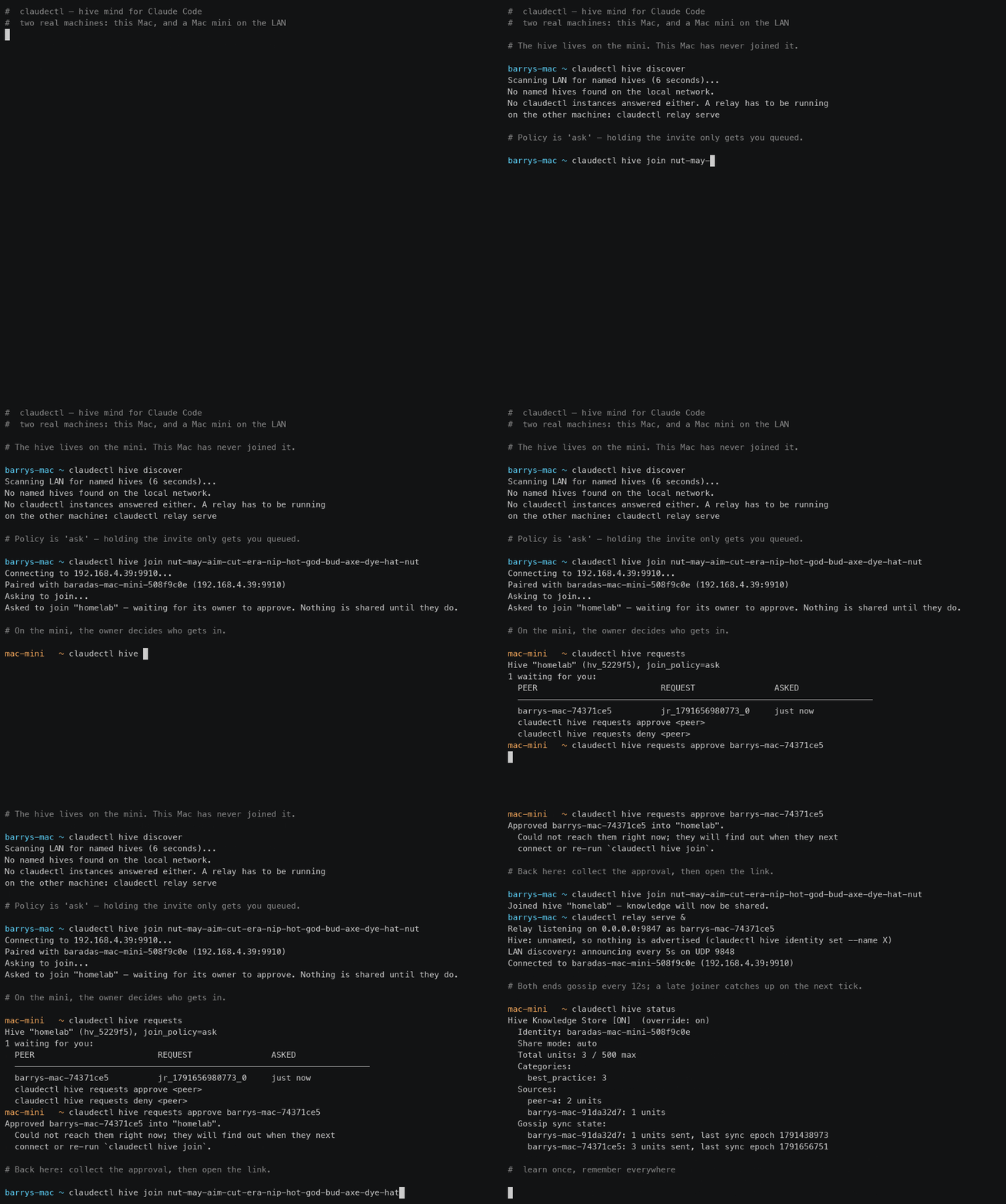
claudectl Hive
claudectl links machines in two layers. Keep them apart when you explain or act:
- Relay connects machines: encrypted TCP links made by pairing. It carries work and state:
relay fleet(every session on every machine),relay delegate,relay send-session. - Hive is the knowledge shared over those links: distilled approve/deny preferences, insights, and skills the user chose to share. Peers gossip it and weight it by trust; local knowledge wins a conflict.
The hive needs the relay. The relay does not need the hive. An unnamed hive is simply everyone this machine has paired with; naming it gives it membership rules (a join policy) on top of pairing.
First, look
Run these before changing anything, and report what they say:
claudectl --version          # both machines should run the same version
claudectl hive identity      # "unnamed", or the hive's name and join policy
claudectl hive status        # membership, units, gossip sync per peer
claudectl relay peers        # paired machines: live / stale / never, last heard, address
Is a relay already listening? On macOS the background agent is io.claudectl.relay:
launchctl list | grep io.claudectl.relay
lsof -nP -iTCP -sTCP:LISTEN | grep claudectl
Start a hive (the host)
- Keep a relay running. Prefer the background agent over a foreground
relay serve, because it survives logout:claudectl relay install-agent - Name the hive.
askmakes every join wait for the owner's approval, which is the right default when anyone other than the owner will join:
Never pickclaudectl hive identity set --name <name> --description "<what it is for>" --join-policy ask--join-policy openon your own initiative. It lets any machine that sees the LAN broadcast join without approval. Only set it when the user asks for it by name. - Mint an invite and hand it to the user:
The invite carries the pairing secret. Give it to the user to pass on privately. Do not post it to a channel, issue, PR or any shared document.claudectl hive invite --words # link, relay code and word phrase claudectl hive invite --qr # QR of the link
Join a hive (the other machine)
claudectl hive join <link | relay code | word phrase>
claudectl relay install-agent                     # keep this side's relay up too
hive join dials the address inside the invite, pairs, records membership and exits. If it cannot reach that address it fails with connection failed and saves nothing, so the joiner must be able to reach the host's address as printed in the invite.
The joiner then has to dial the host for knowledge to move. join prints the line to do it:
claudectl relay connect <host-address>:<port>
relay connect stays in the foreground to hold the link open and only stops on ctrl-c. Ask the user to run it in its own terminal, or start it as a background command. Never run it inline before other steps: it will not return. claudectl hive status then reads asked to join "<name>" ... awaiting owner approval until the host approves.
To pair a machine without joining a named hive (only to delegate work or move sessions), use claudectl relay invite on one side and claudectl relay join <code> on the other.
Approve who gets in (the host)
claudectl hive requests                     # who is waiting, and who is in
claudectl hive requests approve <peer-id>
claudectl hive requests deny <peer-id>
Approving and denying are the owner's decisions. Show the user the waiting list and let them choose. A denial cannot be undone by the peer asking again, so never deny a request just to clear it.
Share a skill with the hive
claudectl hive share skill <path/to/SKILL.md>    # --scope universal | language:X | project:X
claudectl hive shared                             # what peers have shared
claudectl hive pending                            # received, not yet accepted
Installing something a peer shared runs that peer's instructions on this machine. List it with hive pending and let the user accept it.
In the TUI
pon the dashboard toggles the peers panel: state, trust, units sent and received, sessions per peer.K, thenTab, opens the Hive tab:hstart listener,iinvite,Jjoin,rrefresh.Son a session sends that conversation to a paired machine.
When something looks wrong
Address already in usefromrelay serve. A relay is already listening, almost always the launchd agent. Nothing to fix. Skiprelay serveand go on to the invite.- The invite shows a LAN address and the other person is elsewhere. A
192.168.x.xaddress only works on the same network, and the invite cannot be pointed at another address. Joining with that code fails before anything is saved, andrelay connectto a Tailscale address afterwards finds no pairing key. Tell the user the joiner has to be on the host's network (or reach that LAN address through a VPN route) when they redeem it. - A paired peer shows
staleorneverinrelay peers. Pairing is a stored key and outlives the connection, so a machine that is off, asleep or gone stays listed. The supervisor places no work on it, anddelegate/send-sessionto it will fail to connect.claudectl relay prunelists the ones quiet for a week (--older-thanto change it); show the user the list and run--yesonly if they agree. It never removes a peer the hive depends on. - A peer shows
0 unitsandlast sync epoch 0. That means nothing has been sent yet, not that the peer is disconnected. Checkrelay peersfor a recent heartbeat andhive requestson the host for membership. Units only exist once the brain has distilled some decisions. - Names like
peer-a,peer-b,host-1,ku_local,ku_remoteorku_1inhive status,trust.jsonor~/.claudectl/hive/conflicts.jsonl. These are test fixtures written bycargo testinto the real~/.claudectl(#603), not peers and not real conflicts. Tell the user. Do not delete them without asking, and back up~/.claudectl/hivebefore anyone does. - A join between two of the user's own machines is silently closed while both relays run (#608). Stop the joining machine's relay for the join, then start it again. On macOS the agent is
io.claudectl.relay; ask the user before stopping it:launchctl bootout gui/$(id -u)/io.claudectl.relay # stop claudectl hive join <invite> launchctl bootstrap gui/$(id -u) ~/Library/LaunchAgents/io.claudectl.relay.plist # start again - A command from this skill is missing. The machine runs an older claudectl. Compare
claudectl --versionon both sides and upgrade (brew upgrade claudectl).
Run claudectl doctor for a full install and runtime check.