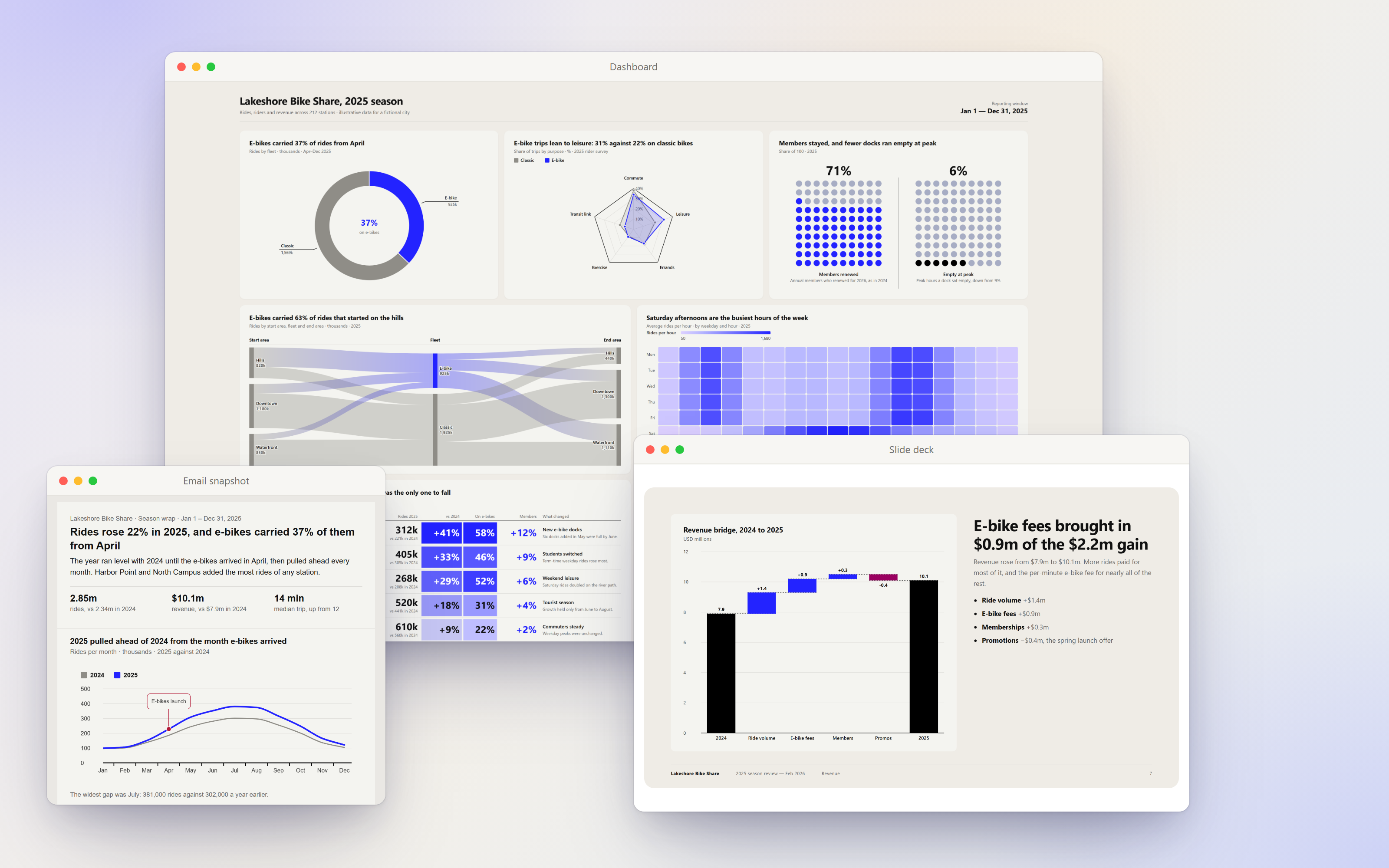
Action titles
A slide titled "Site Visits" makes the audience find the point. A slide titled "Site
visits rose 12% in May to 8,900" hands it to them, and the chart underneath proves it. That is an
action title, and a deck of them can be read from the titles alone.
The product is the evidence bound. Anyone can write a punchy headline. Writing one that
the slide beneath it actually proves — every figure on the slide, no cause it doesn't state,
no adjective it can't back — is the hard part, and the reason to use this instead of asking
for "better titles". Its twin is the flag: a current title that claims more than its slide
shows is the most dangerous line in the deck, because the author believes it.
Workflow
1. Take the deck as given
A .pptx / .potx path, or slide text pasted into chat (a heading per slide, then its
content). Read every slide once: title, visible text, tables, native chart data, and speaker
notes. Number slides S1…Sn in deck order.
Read references/what-a-title-may-say.md §1 before extracting — it says what counts as
evidence (the slide as the audience sees it; not the notes, not other slides, not
numbers guessed off a picture of a chart) and how to record a locator for each figure.
Ask nothing unless genuinely blocked. One question, and only this one:
- No deck and no slide text → "Send the deck (or paste the slides) and I'll retitle them."
Never ask about audience, tone, length or style. Draft first.
2. Sort and choose — by the reference, not by feel
For each slide, in order, apply the reference:
- §2 — structural (cover, agenda, dividers, appendix, closing)? Then it's only listed.
- §3 — the slide's finding, chosen by the fixed order.
- §4 — the verdict, from a closed set of five:
Retitled, Keep, Unsupported,
Two findings, No single finding.
- §5 — the wording rules, checked word by word: every figure on the slide or one shown
step from it, rates in points, certainty words kept, no cause or sequence the slide doesn't
state, no verdict adjectives or intensity verbs, the deck's own terms, ≤ 15 words.
Those tables are the skill; do not improvise them.
3. Write it and stop
**ops-review.pptx** · 8 slides · 2 retitled · 1 kept · 1 unsupported · 1 two findings · 3 left as is

**S3 · Retitled**
Now: Orders
New: Orders rose 17% in March to 5,480

**S4 · Keep**
Now: NPS reached 41 in Q2, above the target of 40

**S5 · Unsupported**
Now: Courier switch caused the jump in returns
New: Returns rose 3.3 pts to 6.4%
The slide shows the rise but nothing about the courier switch.

**S6 · Two findings**
Now: Delivery and Cost
New: On-time delivery fell 3 pts to 85% · Warehouse cost per order fell to £2.10 from £2.40
Split into two slides, or tell me which one leads.

**S7 · Retitled**
Now: Incidents
New: Open incidents more than doubled to 96; June target of 50 at risk

Left as is: S1 cover · S2 agenda · S8 closing

Ask "where does S3's title come from?" or "why didn't you retitle S4?" to see the evidence behind any title.
(Invented example.)
- Header: file name (or Pasted slides), slide count, then the count of each verdict that
occurs, then left as is. Omit a verdict with a count of zero.
- One entry per content slide, in deck order:
S<n> · <verdict>, Now: always (the
original stays visible), New: for every verdict except Keep and No single finding.
- A reason line only for
Unsupported (what the slide lacks), Two findings (split or
pick) and No single finding (what would give it one). Retitled and Keep get none.
Reason lines are written from the slide alone — say what kind of evidence is missing
("a measured figure", "the cause, stated on the slide"), never a topic, figure or theory
taken from the speaker notes. The notes surface only when the user asks (see Tracing).
- Left as is — one line listing structural slides by handle and kind. Omitted if none.
- The closing line ends the output, nothing after it. It cites the first slide with a
New: line and the first content slide without one (
Keep, No single finding). If
every content slide has a New: line, the second half reads "why does S6 say that?" with
the first Unsupported or Two findings slide, or is dropped if there is none.
Output lands in chat. Nothing before the header — no preamble, no "Here are your titles".
No commentary on the deck's design, order or story; only titles.
4. Writing a retitled copy — only when asked
When the user asks to apply the titles ("update the deck", "save a version"):
- Write a copy named
<original name> (action titles).pptx beside the original. Never
overwrite the original.
- Change only the title placeholder text of
Retitled and Unsupported slides, keeping
the placeholder's formatting (replace the text of the first run, remove the others). Nothing
else on any slide changes — not bodies, notes, order or layout.
Two findings slides are left alone unless the user picks a lead; Keep, No single finding and structural slides are never touched.- Say in one line what was written and which slides changed.
Pasted slides get no file — the titles are already copyable.
Rules
- The slide is the evidence. Its visible text, tables and native chart data. Not the
notes, not another slide, not a picture's bar heights, not what the author "knows".
- Flag, don't fix silently. A current title that claims more than the slide shows is
Unsupported, with the reason — never quietly replaced as if it had been a label.
- Never supply a cause. A causal word needs the slide to state the cause; a sequence word
needs the slide to show both events. The notes' theory is not the slide's.
- Never firm anything up. Forecast, target, at risk, estimate survive into the
title. A forecast is never an outcome.
- Never soften bad news. A miss or a risk on the slide rides in its title, and leads
when it's the finding. "Update" and "progress" are not titles for a slide that says at
risk.
- Don't manufacture a headline. A slide with no finding keeps a descriptive title. That is
the honest answer, not a failure.
- User intent doesn't override evidence. If the author says the point is X and the slide
doesn't show X, say what's missing and what the title could say once it's added — don't
write X. A conditional title offered this way obeys every wording rule, the 15-word limit
included.
- "Punchier" means shorter and number-first — never an adjective, an intensity verb or a
rounder number.
Tracing
A title is a one-line claim about a slide, so every doubt is about the evidence under it or
about a slide that wasn't changed. Read references/tracing.md before answering any
follow-up: it carries the handles (S1…Sn), the fixed closing line, the trace block
(Evidence · Working · Why this finding · Word check · What would change it), the not-retitled
block, and the questions to expect — "where does 17% come from?", "why didn't you change
S4?", "that's not the point of this slide", "it obviously was the courier switch",
"make it punchier", and above all "why did returns jump?" — which gets only what the slide
states, the notes quoted and marked as not on the slide, or "the slide doesn't say."
A trace re-reads the slide and corrects the title when it fails: a figure that doesn't
reproduce is fixed, a dropped forecast is restored, a verdict that should have been
Unsupported is changed — each said first.
1---2name: action-titles3description: Rewrite a deck's slide titles as the claim each slide proves — "Orders rose 17% in March to 5,480", not "Orders" — and flag every current title that claims more than its slide shows. Use when the user has a PowerPoint deck (.pptx) or pasted slide text and says the titles are just labels, wants headline or action titles, "so-what" titles, takeaway titles, or wants the deck to tell its story through the titles before a QBR, board or client meeting. Every number in a new title is on that slide; no cause, verdict or adjective the slide doesn't state. Keeps the original title beside each suggestion; writes a retitled copy only when asked.4metadata:5 source: https://skillmd.com/skills/raghuramsirigiri/action-titles6---78# Action titles910A slide titled "Site Visits" makes the audience find the point. A slide titled "Site11visits rose 12% in May to 8,900" hands it to them, and the chart underneath proves it. That is an12**action title**, and a deck of them can be read from the titles alone.1314**The product is the evidence bound.** Anyone can write a punchy headline. Writing one that15the slide beneath it actually proves — every figure on the slide, no cause it doesn't state,16no adjective it can't back — is the hard part, and the reason to use this instead of asking17for "better titles". **Its twin is the flag:** a current title that claims more than its slide18shows is the most dangerous line in the deck, because the author believes it.1920## Workflow2122### 1. Take the deck as given2324A `.pptx` / `.potx` path, or slide text pasted into chat (a heading per slide, then its25content). Read every slide once: title, visible text, tables, native chart data, and speaker26notes. Number slides `S1…Sn` in deck order.2728Read `references/what-a-title-may-say.md` §1 before extracting — it says what counts as29evidence (the slide as the audience sees it; **not** the notes, **not** other slides, **not**30numbers guessed off a picture of a chart) and how to record a locator for each figure.3132**Ask nothing unless genuinely blocked.** One question, and only this one:33- No deck and no slide text → *"Send the deck (or paste the slides) and I'll retitle them."*3435Never ask about audience, tone, length or style. Draft first.3637### 2. Sort and choose — by the reference, not by feel3839For each slide, in order, apply the reference:4041- **§2** — structural (cover, agenda, dividers, appendix, closing)? Then it's only listed.42- **§3** — the slide's finding, chosen by the fixed order.43- **§4** — the verdict, from a closed set of five: `Retitled`, `Keep`, `Unsupported`,44 `Two findings`, `No single finding`.45- **§5** — the wording rules, checked word by word: every figure on the slide or one shown46 step from it, rates in points, certainty words kept, no cause or sequence the slide doesn't47 state, no verdict adjectives or intensity verbs, the deck's own terms, ≤ 15 words.4849Those tables are the skill; do not improvise them.5051### 3. Write it and stop5253```markdown54**ops-review.pptx** · 8 slides · 2 retitled · 1 kept · 1 unsupported · 1 two findings · 3 left as is5556**S3 · Retitled**57Now: Orders58New: Orders rose 17% in March to 5,4805960**S4 · Keep**61Now: NPS reached 41 in Q2, above the target of 406263**S5 · Unsupported**64Now: Courier switch caused the jump in returns65New: Returns rose 3.3 pts to 6.4%66The slide shows the rise but nothing about the courier switch.6768**S6 · Two findings**69Now: Delivery and Cost70New: On-time delivery fell 3 pts to 85% · Warehouse cost per order fell to £2.10 from £2.4071Split into two slides, or tell me which one leads.7273**S7 · Retitled**74Now: Incidents75New: Open incidents more than doubled to 96; June target of 50 at risk7677Left as is: S1 cover · S2 agenda · S8 closing7879Ask "where does S3's title come from?" or "why didn't you retitle S4?" to see the evidence behind any title.80```8182(Invented example.)8384- **Header**: file name (or *Pasted slides*), slide count, then the count of each verdict that85 occurs, then *left as is*. Omit a verdict with a count of zero.86- **One entry per content slide**, in deck order: `S<n> · <verdict>`, *Now:* always (the87 original stays visible), *New:* for every verdict except `Keep` and `No single finding`.88- **A reason line only** for `Unsupported` (what the slide lacks), `Two findings` (split or89 pick) and `No single finding` (what would give it one). `Retitled` and `Keep` get none.90 **Reason lines are written from the slide alone** — say what *kind* of evidence is missing91 (*"a measured figure"*, *"the cause, stated on the slide"*), never a topic, figure or theory92 taken from the speaker notes. The notes surface only when the user asks (see Tracing).93- **Left as is** — one line listing structural slides by handle and kind. Omitted if none.94- **The closing line** ends the output, nothing after it. It cites the **first** slide with a95 *New:* line and the **first** content slide without one (`Keep`, `No single finding`). If96 every content slide has a *New:* line, the second half reads *"why does S6 say that?"* with97 the first `Unsupported` or `Two findings` slide, or is dropped if there is none.9899Output lands in chat. **Nothing before the header** — no preamble, no "Here are your titles".100No commentary on the deck's design, order or story; only titles.101102### 4. Writing a retitled copy — only when asked103104When the user asks to apply the titles ("update the deck", "save a version"):105106- Write a **copy** named `<original name> (action titles).pptx` beside the original. Never107 overwrite the original.108- Change **only the title placeholder text** of `Retitled` and `Unsupported` slides, keeping109 the placeholder's formatting (replace the text of the first run, remove the others). Nothing110 else on any slide changes — not bodies, notes, order or layout.111- `Two findings` slides are left alone unless the user picks a lead; `Keep`, `No single112 finding` and structural slides are never touched.113- Say in one line what was written and which slides changed.114115Pasted slides get no file — the titles are already copyable.116117## Rules118119- **The slide is the evidence.** Its visible text, tables and native chart data. Not the120 notes, not another slide, not a picture's bar heights, not what the author "knows".121- **Flag, don't fix silently.** A current title that claims more than the slide shows is122 `Unsupported`, with the reason — never quietly replaced as if it had been a label.123- **Never supply a cause.** A causal word needs the slide to state the cause; a sequence word124 needs the slide to show both events. The notes' theory is not the slide's.125- **Never firm anything up.** *Forecast*, *target*, *at risk*, *estimate* survive into the126 title. A forecast is never an outcome.127- **Never soften bad news.** A miss or a risk on the slide rides in its title, and leads128 when it's the finding. "Update" and "progress" are not titles for a slide that says *at129 risk*.130- **Don't manufacture a headline.** A slide with no finding keeps a descriptive title. That is131 the honest answer, not a failure.132- **User intent doesn't override evidence.** If the author says the point is X and the slide133 doesn't show X, say what's missing and what the title could say once it's added — don't134 write X. A conditional title offered this way obeys every wording rule, the 15-word limit135 included.136- **"Punchier" means shorter and number-first** — never an adjective, an intensity verb or a137 rounder number.138139## Tracing140141A title is a one-line claim about a slide, so every doubt is about the evidence under it or142about a slide that wasn't changed. Read `references/tracing.md` before answering any143follow-up: it carries the handles (`S1…Sn`), the fixed closing line, the trace block144(*Evidence · Working · Why this finding · Word check · What would change it*), the not-retitled145block, and the questions to expect — *"where does 17% come from?"*, *"why didn't you change146S4?"*, *"that's not the point of this slide"*, *"it obviously was the courier switch"*,147*"make it punchier"*, and above all *"why did returns jump?"* — which gets only what the slide148states, the notes quoted and marked as not on the slide, or *"the slide doesn't say."*149150A trace re-reads the slide and **corrects the title** when it fails: a figure that doesn't151reproduce is fixed, a dropped *forecast* is restored, a verdict that should have been152`Unsupported` is changed — each said first.