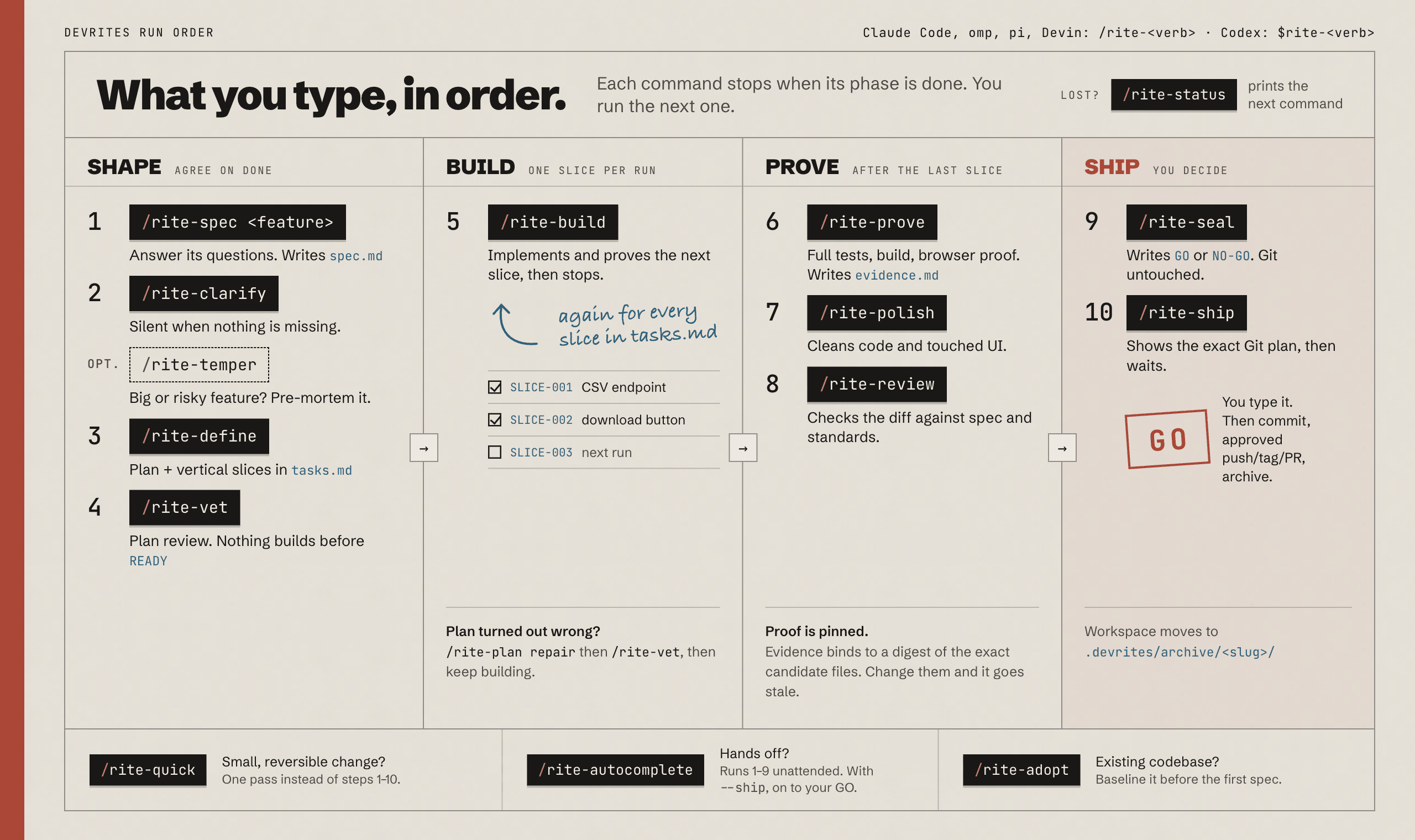
Read-set manifest: devrites-engine context --skills-root .omp/skills <slug> --skill devrites-frontend-craft (no workspace: --out <path>) bundles every file named below into one deduplicated read. Trigger names map to the conditional rules in the sections that follow.
devrites-frontend-craft: UI like a senior designer-engineer
Build UI that belongs in this product, handles every state, and avoids generic-AI
tells. Integrated into the feature slice, not a separate design project.
1. Foundation discovery
Framework, routing, components, tokens, CSS methodology, icon set, existing UI patterns,
and any PRODUCT.md / DESIGN.md / design docs. Use the project's system: don't
import a new one. (Detail: reference/design-references.md.)
- Load the design brief + references the spec gathered (roles: target / constraint / inspiration — detail:
reference/design-references.md).
Reuse first: search before you build
Before creating any new component, style, token, icon, hook, util, or helper, search the
project for an existing one and reuse → extend → build new: see
reference/reuse-first.md for the search targets, the AHA
caveat, and the per-slice reuse record.
2. Register detection
Read the discovery and register contract in
reference/design-references.md.
Completion: the surface is classified as brand or product and its existing tokens,
components, patterns, and nearest neighbor are named before design choices begin.
3. Shape before code: build to the brief (reference/shape.md)
The feature's design-brief.md is your target: /rite-spec shaped it up front
(devrites-ux-shape): design direction, key states, interaction model, the visual-direction
probe. Read it first and refine it for this slice's surface; don't re-derive the design
from scratch. Confirm the slice covers the brief's states for this surface (default,
loading, empty, error, success, disabled, long-content), its information hierarchy +
primary action, responsive behavior, a11y, interaction model, and proof targets. If a UI slice has no
design-brief.md (a spec written before shaping), shape it now via devrites-ux-shape
before coding. Ask before coding if the visual direction or UX flow is still ambiguous.
4. Build (reference/craft.md)
- Compose from existing components/tokens (reuse-first, above) before reaching for new code.
- Build the smallest UI the current slice needs: don't pre-build screens.
- Don't add a second component library or icon set without asking.
- Cover the states you shaped, not just the happy path.
- Reduce cognitive load: no wall of options: group, mark the recommended choice, use
progressive disclosure.
- Copy in the product's voice; shift tone by moment: success brief, error empathetic
- actionable, loading reassuring, destructive serious. Never humor in errors. Empty
states say why + the next action.
- First-use: get the user to first value fast; onboarding proves worth, it doesn't
teach the whole product.
5. Verify & record (meet the bar)
- Hit the 2026 quality bar: Core Web Vitals
(LCP ≤2.5s / INP ≤200ms / CLS ≤0.1), WCAG 2.2 AA (keyboard, visible focus, contrast,
≥24px targets / 44px touch, no drag-only), responsive at 320/768/1024/1440, visible
focus meeting SC 2.4.7/1.4.11 (browser-chrome theming is an optional design-system
choice), and run its verification gate (no console errors, no axe violations;
incomplete rows resolved as manual rows; every role-applicable state).
- Run the visual convergence loop in the browser (using
devrites-browser-proof; deltas land in its Visual Verdict scorecard): render the
slice's named states/viewports/input modes, open the screenshots, compare them with the
brief + target R-ids, record material deltas, fix, and re-render until none remain. A
detector/checklist is a floor, not the visual verdict.
- Every interactive element has an asserting test at the right level: each field,
checkbox, radio, select, toggle, button, and actionable link gets a unit/component test for
what it does (validation, toggle, options, enabled/disabled, handler); critical journeys
get one E2E. Browser proof shows it renders; the asserting test proves it works. No element
ships unverified:
testing.md "Completeness"; inventory in test-plan.md.
- Append build-time refinements to
design-brief.md (§3); /rite-polish Phase 4 and
/rite-seal's frontend reviewer read it. Record runtime evidence in browser-evidence.md.
Fullstack (frontend + backend in one feature)
When the feature needs both sides, follow reference/fullstack.md:
define the API/data contract first (devrites-api-interface), slice vertically
through the layers (DB → service → API → UI) one capability at a time, apply the
engineering rules to the backend and this craft to the frontend, map every contract error
to a real UI state, and prove both layers (contract tests + browser proof).
Anti-AI-slop
The banned-defaults list and the countable mechanical pre-flight live in
anti-ai-slop.md (canonical owner): run both at build and polish
time — a slop pattern in the slice is a polish finding.
Default vs departure
Preserve the existing identity (default, ~90%). Reject it only on an explicit signal (a
design doc naming this surface as the failure, or the user asking to rebuild). If
unsure, you're in default mode: the cost of a wrong departure is unrecoverable.
1---2name: devrites-frontend-craft-63description: Build accessible production UI and all states during /rite-build. Use for frontend or design-system implementation; not for polish or design exploration.4user-invocable: false5metadata:6 source: https://skillmd.com/skills/viktorsbaikers/devrites-frontend-craft-67---89<!-- loads: {"always":["devrites-frontend-craft/reference/craft.md","devrites-frontend-craft/reference/design-references.md","devrites-frontend-craft/reference/quality-standards.md","devrites-frontend-craft/reference/reuse-first.md","devrites-frontend-craft/reference/shape.md","rite-polish/reference/anti-ai-slop.md"],"triggers":{"fullstack":["devrites-frontend-craft/reference/fullstack.md"],"testing":["devrites-lib/reference/standards/testing.md"]}} -->10> Read-set manifest: `devrites-engine context --skills-root .omp/skills <slug> --skill devrites-frontend-craft` (no workspace: `--out <path>`) bundles every file named below into one deduplicated read. Trigger names map to the conditional rules in the sections that follow.1112# devrites-frontend-craft: UI like a senior designer-engineer1314Build UI that belongs in *this* product, handles every state, and avoids generic-AI15tells. Integrated into the feature slice, not a separate design project.1617## 1. Foundation discovery18Framework, routing, components, tokens, CSS methodology, icon set, existing UI patterns,19and any `PRODUCT.md` / `DESIGN.md` / design docs. Use the project's system: don't20import a new one. (Detail: `reference/design-references.md`.)21- Load the design brief + references the spec gathered (roles: target / constraint / inspiration — detail: `reference/design-references.md`).2223## Reuse first: search before you build24Before creating any new component, style, token, icon, hook, util, or helper, search the25project for an existing one and **reuse → extend → build new**: see26[reference/reuse-first.md](reference/reuse-first.md) for the search targets, the AHA27caveat, and the per-slice reuse record.2829## 2. Register detection30Read the discovery and register contract in31[`reference/design-references.md`](reference/design-references.md#discover-these).32Completion: the surface is classified as brand or product and its existing tokens,33components, patterns, and nearest neighbor are named before design choices begin.3435## 3. Shape before code: build to the brief ([reference/shape.md](reference/shape.md))36The feature's **`design-brief.md`** is your target: `/rite-spec` shaped it up front37(`devrites-ux-shape`): design direction, key states, interaction model, the visual-direction38probe. **Read it first and refine it for this slice's surface; don't re-derive the design39from scratch.** Confirm the slice covers the brief's states for this surface (default,40loading, empty, error, success, disabled, long-content), its information hierarchy +41primary action, responsive behavior, a11y, interaction model, and proof targets. **If a UI slice has no42`design-brief.md`** (a spec written before shaping), shape it now via `devrites-ux-shape`43before coding. **Ask before coding if the visual direction or UX flow is still ambiguous.**4445## 4. Build ([reference/craft.md](reference/craft.md))46- Compose from existing components/tokens (reuse-first, above) before reaching for new code.47- Build the **smallest UI** the current slice needs: don't pre-build screens.48- Don't add a second component library or icon set without asking.49- Cover the states you shaped, not just the happy path.50- **Reduce cognitive load:** no wall of options: group, mark the recommended choice, use51 progressive disclosure.52- **Copy in the product's voice**; shift tone by moment: success brief, error empathetic53 + actionable, loading reassuring, destructive serious. Never humor in errors. Empty54 states say *why* + the next action.55- **First-use**: get the user to first value fast; onboarding proves worth, it doesn't56 teach the whole product.5758## 5. Verify & record (meet the bar)59- Hit the [2026 quality bar](reference/quality-standards.md): Core Web Vitals60 (LCP ≤2.5s / INP ≤200ms / CLS ≤0.1), WCAG 2.2 AA (keyboard, visible focus, contrast,61 ≥24px targets / 44px touch, no drag-only), responsive at 320/768/1024/1440, visible62 focus meeting SC 2.4.7/1.4.11 (browser-chrome theming is an optional design-system63 choice), and run its verification gate (no console errors, no axe violations;64 `incomplete` rows resolved as manual rows; every role-applicable state).65- Run the **visual convergence loop** in the browser (using `devrites-browser-proof`; deltas land in its Visual Verdict scorecard): render the66 slice's named states/viewports/input modes, open the screenshots, compare them with the67 brief + target R-ids, record material deltas, fix, and re-render until none remain. A68 detector/checklist is a floor, not the visual verdict.69- **Every interactive element has an asserting test at the right level:** each field,70 checkbox, radio, select, toggle, button, and actionable link gets a unit/component test for71 what it *does* (validation, toggle, options, enabled/disabled, handler); critical journeys72 get one E2E. Browser proof shows it renders; the asserting test proves it works. No element73 ships unverified: [`testing.md`](skill://devrites-lib/reference/standards/testing.md) "Completeness"; inventory in `test-plan.md`.74- **Append build-time refinements** to `design-brief.md` (§3); `/rite-polish` Phase 4 and75 `/rite-seal`'s frontend reviewer read it. Record runtime evidence in `browser-evidence.md`.7677## Fullstack (frontend + backend in one feature)78When the feature needs both sides, follow [reference/fullstack.md](reference/fullstack.md):79define the **API/data contract first** (`devrites-api-interface`), slice **vertically**80through the layers (DB → service → API → UI) one capability at a time, apply the81engineering rules to the backend and this craft to the frontend, map every contract error82to a real UI state, and **prove both layers** (contract tests + browser proof).8384## Anti-AI-slop85The banned-defaults list and the countable mechanical pre-flight live in86[`anti-ai-slop.md`](skill://rite-polish/reference/anti-ai-slop.md) (canonical owner): run both at build and polish87time — a slop pattern in the slice is a polish finding.8889## Default vs departure90Preserve the existing identity (default, ~90%). Reject it only on an explicit signal (a91design doc naming *this* surface as the failure, or the user asking to rebuild). If92unsure, you're in default mode: the cost of a wrong departure is unrecoverable.