
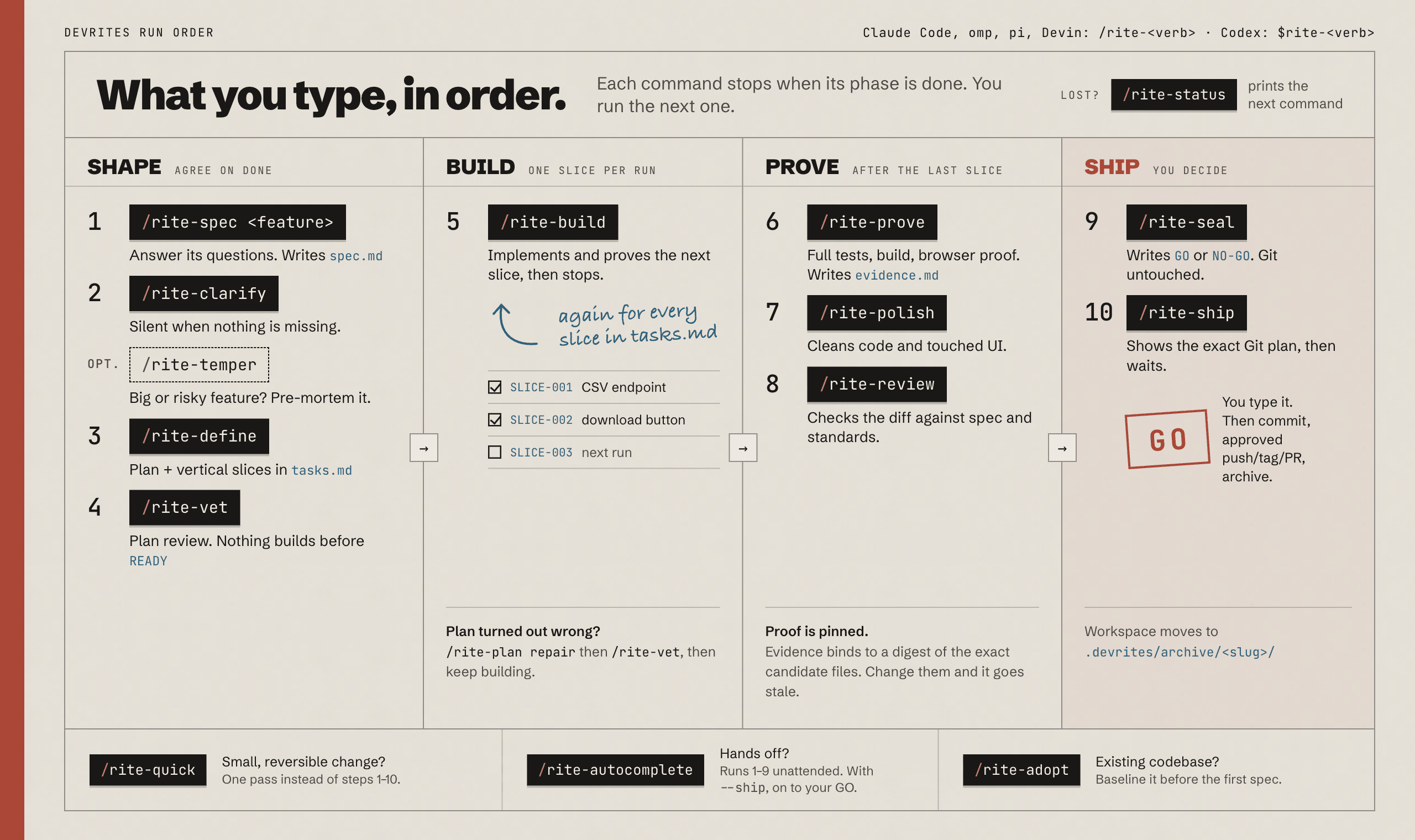
Read-set manifest:
devrites-engine context --skills-root .devin/skills <slug> --skill devrites-interview(no workspace:--out <path>) bundles every file named below into one deduplicated read.
devrites-interview: extract intent
Resolve the difference between the request and the user's intent before writing a spec, plan, or code.
Protocol
- Open with a working hypothesis. State in one line what the user wants, then ask about the highest-value unresolved human-owned material decision.
- One question per turn. Multiple questions get one answered and the rest ignored.
- Attach an explicit recommendation and its reason to every question:
"I recommend CSV only because it covers the use case. Choose CSV, CSV + XLSX, or something else?" This is a concrete candidate for the user's decision, not an assumption or confirmation.
- Ask in a full sentence that names the decision and why it changes the build — "Which export formats must v1 ship? Each adds a writer and a proof." — never a bare label ("Formats?") or a context-free "any preference?"
- Highest-value question first: order by how much the answer changes the build. A question that moves the data model or acceptance criteria beats a cosmetic one.
- Prioritize impact and bound each pass. Order unknowns scope > security/privacy > UX >
technical. A pass MAY contain at most 3 questions for cognitive load. After each pass,
rescan the decision tree and continue in later turns until every human-owned material decision
is explicitly selected or explicitly deferred by the user. A cap MUST NOT move a blocker to
assumptions.md. Own and log reversible, low-impact technical details instead of asking. - Structured options when the space is enumerable: present them as the standard ranked
option set (
afk-hitl.md→ "Option set"): recommended first, labelled(Recommended), each with a dimension-tagged rationale (logic · infra · business · architecture, +security/UX/riskwhen in scope), plus the escape hatch. Render viaask_user_questionwhen the harness has it:1. <recommended> (Recommended) — logic: … · infra: … · business: … · architecture: … 2. <alternative> — <rationale + the trade-off it accepts> 3. Something else — I'll describe it
Completion condition
Complete only when a topology and decision-tree rescan finds no unresolved human-owned material decision. Such a decision closes only through the user's option selection, free-form answer, or explicit deferral. A recommendation is not confirmation. If the user stops early, persist every visible blocker and MUST NOT claim readiness or advance.
Ask fewer, deeper questions. If answers stop converging around one area, reframe once instead of asking another version of the same question.
Want vs. should-want
Users sometimes name the convention or best practice they think they should want instead of their actual preference. Signals include abstract virtues ("scalable", "clean", "modern"), deference to convention, or an answer that fits any project. Ask: "if you didn't have to justify this to anyone, what would you want?" Record that answer rather than designing to the generic one.
What counts as a yes
Approval requires an explicit yes. Treat these replies differently:
- "Whatever you think is best" / "you decide": delegation, not approval. Offer two concrete options so the user chooses the substance or explicitly defers it.
- "Sounds good" / "sure, let's go": confirm once for a material decision rather than treating a polite exit as approval.
- Silence: not consent. State what is out of scope and get explicit approval for it.
Don't ask
- Things the codebase answers (read it first).
- Reversible, low-impact technical details (decide and log as agent-owned assumptions).
- Everything at once "to be thorough."
When the ask is vague: map the decision tree first
For a short or vague request ("design a contact page"), do not ask isolated questions.
Sketch the decision tree first, then resolve each branch depth-first with the
protocol above. Domain branches per area:
../rite-spec/reference/interview-patterns.md.
Reframe (once, when stuck)
If the interview is not converging, use one turn to challenge the premise: "is a form even the right answer here, or a mailto / booking link?" Then resume the protocol with the revised premise.
/clarify mode: coverage scan of an existing spec
When clarifying a written spec rather than extracting intent from scratch, first enumerate
its actors, journeys/components, states, data boundaries, interfaces/integrations, and
operational/proof surfaces. Scan every material surface against that taxonomy and mark
closed, agent-owned, not-applicable, deferred-nonblocking, or open with evidence. Ask at most 3 prioritized decision packets per
pass, targeting open rows, one per turn with an explicit recommendation and reason.
A packet may close
several cells only when they share one owner and trade-off.
Integrate each answer into the relevant spec section immediately. A Q&A log alone is
insufficient.
Record each question and resolution in decision-coverage.md as scan evidence, not a
transcript block in spec.md.
Re-run the scan after each pass. Packet limits control cognitive load, never readiness. Continue
later passes while human-owned blockers remain, and stop only when every row is closed, agent-owned,
not-applicable, or deferred-nonblocking by the user with a nonblocking reason, owner, and validation
gate. Then re-score the affected
checklists/<domain>.md.
Output
A short summary for the caller: objective in one sentence, confirmed decisions,
open non-blocking items, and the recommended next step. If a workspace is active, write
Q&A to questions.md, confirmed calls to decisions.md, and only agent-owned reversible,
low-impact technical details to assumptions.md. If not, return the summary without creating
a workspace.