
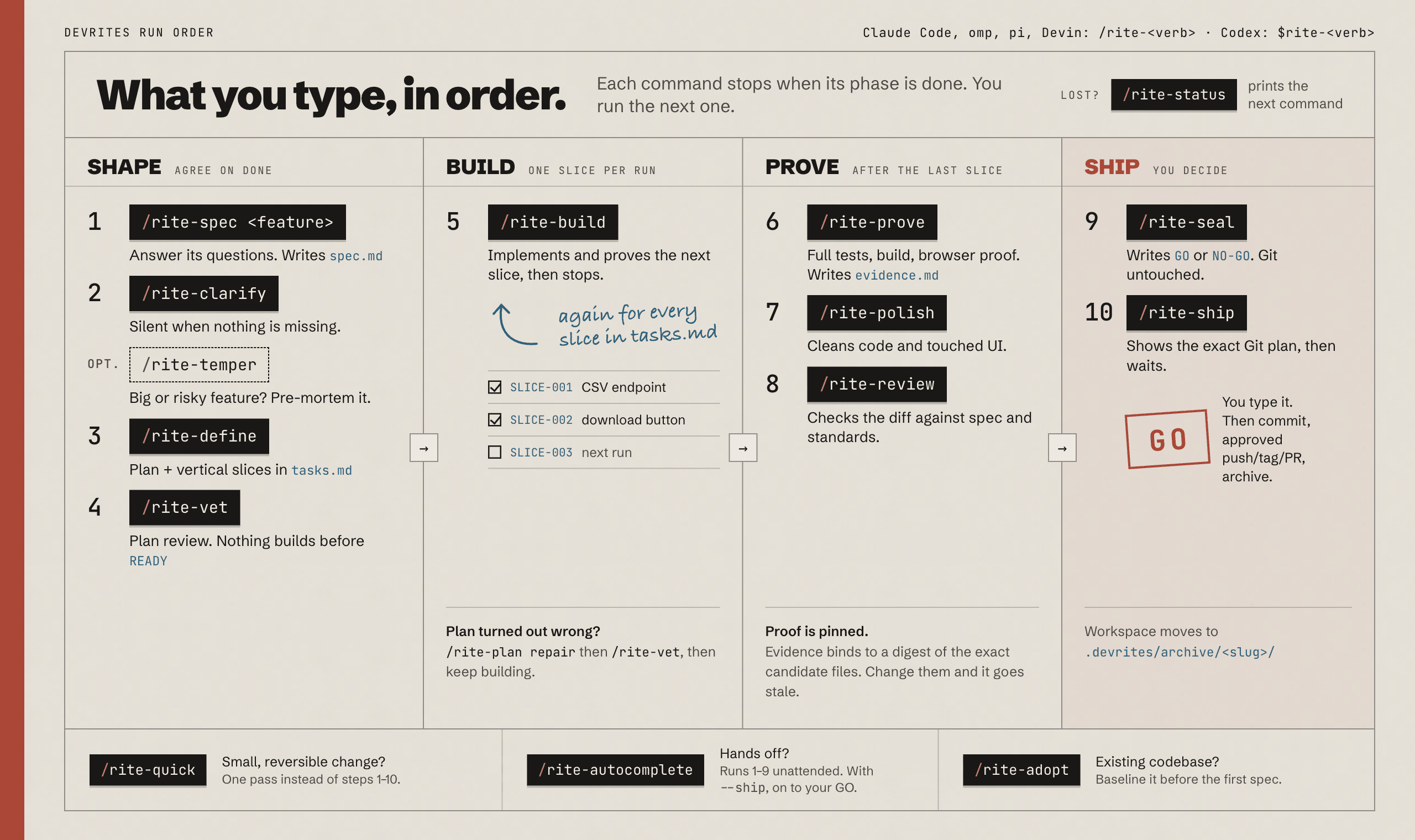
Read-set manifest:
devrites-engine context --skills-root .devin/skills <slug> --phase definebundles every file named below into one deduplicated read. Trigger names map to the conditional rules in the sections that follow.
/rite-define: plan from the spec
Turn spec.md into architecture, vertical slices, traceability, and state. Spec owns
what/why; Define owns how. Do not write code.
Rules consulted (read on demand from .devin/skills/devrites-lib/reference/standards/)
Pull these via Read when shaping the plan:
development-workflow.md: small batches, trunk-always-green, definition of done.principles.md: the project invariants (.devrites/principles.md) the chosen approach must conform to.documentation.md: record plan-time decisions and rationale.repository-topology.md,data-integrity.md, andintegration-reliability.md: load only for matchingspec.mdapplicability rows; each applicable owner is mandatory.../devrites-lib/reference/workspace-artifact-schema.md: artifact purposes, budgets, IDs, and read triggers (triggerworkflow-artifacts).
Operating rules
- Requires a readied spec. Gate conditions and STOP routing are step 0; never plan it.
- Apply
afk-hitl.mdownership. Prefer conventions; source-check new dependencies/design systems, asking only about licensing, cost, security, or policy. - Author one
architecture.md/plan.mdsection at a time. Before slicing, useelicitation.mdTournament for open designs and Delphi for uncertain estimates. - Workflow-only exception. Follow
workflow-artifacts.mdbefore applying product slice rules below: explicit scope, zero product slices, existing empty candidate, AC/REQ → WA behavior/proof mapping in tasks, traceability and test-plan. Keep every AC; never fabricate a slice or dispatch Build for root-owned workflow artifacts. Slice-count, slice-format, writer and cross-slice requirements below apply only when product slices exist. - Derive the slice count from the work.
One per independently-shippable increment, sized by
slicing.md; map every acceptance criterion. User counts are hints: explain honest differences, never pad/compress..devrites/AFKmax_slicesis an iteration budget, not decomposition. A derivation over the feature ceiling is a split signal, never aBudget override: keep the thinnest shippable subset here and route the rest to Non-goals + continuation workspaces via the Drift Guard. - Complexity does not shrink scope. Split/reorder; never drop/defer approved REQ/AC. Reduction needs Drift Guard + human decision; hard/large means decompose.
- Wide refactors use expand → migrate → contract. Add compatibility, migrate green batches, then remove the old path; if batches cannot stay green, use an integration branch plus final verify.
- Root writes; drafter proposes under bounded fresh context
(
agents.md); root owns choices and canonical files.
Workflow
- Read
.devin/skills/devrites-lib/reference/standards/core.md: the always-on operating rules and anti-rationalizations. Resolve source per phase target binding, require itsstate.md, and re-openspec.mdand applyspec-grammar.md's Native grammar re-read checklist. If there is no selected workspace, nospec.md, the checklist fails, or its readiness gate hasn't passed → STOP and tell the user to run/rite-spec <feature>first. Ifdecision-coverage.mdis absent or does not sayDecision coverage: CLEAR, STOP →/rite-clarify. Ifchecklists/has no<domain>.mdor any carries an open CRITICAL fail, STOP →/rite-spec. - Read the spec:
spec.md(objective, requirements, acceptance, placement, design references, gaps/decisions), plusreferences.md,decisions.md,assumptions.md,decision-coverage.md,strategy.mdif present (the scope mode, deferred / out-of-scope register, and pre-mortem risks from/rite-temper: cut slices to mitigate the top risks and respect the IN/OUT line; map coverage against the hardened spec), anddesign-brief.mdif the feature touches UI (the UX/UI contract/rite-specshaped: its key states, interaction model, and proof targets drive how UI slices are cut). If a blocking[NEEDS CLARIFICATION]remains, stop →/rite-clarify. Run thespec-grammar.mdmarker sweep; a kept hit stops the same way, and itsmarker sweep:line goes in the step-7 digest. Reconcile everyApplicability maprow against live repository evidence. Load each applicable standard; a falsenot applicableis a blocking spec gap, not a planning shortcut. 1a. Draft from fresh context. Freeze the planning inputs and dispatchdevrites-plan-drafterindefinemode for one atomic candidate bundle:architecture.md,plan.md,tasks.md, andtraceability.mdwith proof mapping. Validate its bounded result; it does not write/ask, and returns human choices to root. In the same parallel wave, dispatch onedevrites-evidence-scoutper external capability the plan will rest on — OS/SDK/native API, permission or sandbox, file format, toolchain, or third-party behavior — that neither live code nor a cited dossier already proves (at most three, as in Spec). Fold each dossier before step 2a: cite a proven capability inarchitecture.md; an unproven or contradicted one becomes a risk spike ordered before its dependent slices, never an assumption the build discovers. - Reconcile architecture + approach against live seams; root writes at step 6.
architecture.mdowns layers/boundaries/integrations/data/dependencies/risks/impact;plan.mdowns build strategy. Use codebase-memory-mcp for structure/impact (get_architecture,trace_path;code-navigation.md) and source-check external behavior. Record significant options asDEC-###only for non-obvious real trade-offs where independently built lower units could choose incompatibly; leave other details to convention/ slice. Compare ≥2 viable approaches for hard-to-reverse boundaries, models, contracts, or dependencies by drivers, trade-offs, and consequences. Specify cross-boundary interfaces for independent work: invariants, I/O, ordering/idempotency, errors, versioning, config, and relevant budgets. Establish repository/deployable roots, state and contract ownership, shared mutable resources, and deployment order underrepository-topology.md. For applicable durable data or integration rows, include the exact required plan table fromdata-integrity.mdorintegration-reliability.md; do not replace it with "handle retries/migration" prose. For any changed provider/consumer boundary, completeplan.md's canonicalShared contract prooftable with one reused contract artifact and provider- and consumer-side asserting tests that both consume it. Otherwise record the exact justified no-impact statement. Missing, one-sided, duplicated-contract, vague, or non-consuming proof blocks. Deep-module check: prefer small, stable interfaces hiding meaningful, testable behavior. Deepen/delete shallow modules whose interface matches implementation complexity. Put their independent behavior inTests/proof;/rite-vetconfirms. 2a. Decision-horizon sweep. Applyreference/plan-template.md's classification to every question, assumption, architecture/dependency/proof choice, and checkpoint. Resolve planning items from source; only necessary executable evidence warrants a risk spike with discriminating criteria/fallback branches. Human blockers route to/rite-clarify. dispositions perreference/plan-template.md§Decision horizons. - Create vertical tasks: each delivers one independently verifiable, observable
capability end to end; first is the thinnest useful path, ordered by dependency then
risk. Apply the slice-count and broad-refactor rules above plus
slicing.mdandtask-breakdown.md. Write explicitWorkspace dependenciesper canonical slice grammar after checking assumptions, consumed interfaces, runtime resources and proof independence; Plan owns this declaration and Vet approves its current binding. Rundevrites-engine recall --paths <files likely touched>; fold each relevant prior decision, carry-forward constraint, or finding into that slice'sPrior-slice learnings. Mark per slice: Frontend craft required and Browser proof required (UI), and whether it's fullstack (FE+BE → contract first, seefullstack.md). For UI slices, name which ofdesign-brief.md's key states + interaction the slice delivers, and give it a binary Visual acceptance target (state × viewport × input + target R-id/brief rule), so the design contract maps to slices as well as acceptance criteria.Tests/proofnames exact command, cwd, expected signal, prerequisites, and mutable provenance inputs;/rite-vetpreflights them. Write the portable repository command, never RTK/local wrappers, user-specific absolute paths, or temporary proof trees. When a shared contract changes, order its canonical artifact before both asserting tests and make provider/consumer dependencies explicit. Each exactCharacterization: characterize-before-modifyrow is the first touching slice's prerequisite: observe and test unchanged baseline green, perturb realistic behavior red, restore green, then modify. Never expand this into repository-wide coverage. - Map coverage and wiring: every
AC-###spec acceptance criterion maps to ≥1SLICE-###(acceptance-criteria.md); no orphaned criteria, no slice without a criterion except a deferred slice. Every proof row quotes the spec line it proves (Proves); proof that proves none goes totest-plan.md## Deferred hardening, never into a slice (artifacts.md). Lift covered/backstopEdge Coveragerows and resolvedProhibitions (must-NOT)rows intotraceability.mdandtest-plan.md; unresolved rows get a gate/owner. EachExisting behavior to preserverow becomes a regression row whose current evidence is observed green on the unchanged baseline at Vet (preflightRun atvet), again before the first slice touching that seam edits it, and green at Prove; a red baseline is recorded pre-existing, never relabelled. A slice whoseFiles likely touchednames a manifest or lockfile also plans adependency-dry-run SLICE-###preflight row (artifacts.md). Mark a proof rowRUN: writeronly when it is local, needs no network, container or browser, and passes in an uncommitted worktree (an empty-git diffcheck stays root); itsgates.mdgate carries the attribute, the wright pre-runs it viagates precheck, and root still runs it. Evidence that cannot run takescharacterize-before-modifyor blocks. Each cross-slice boundary names producer, consumer, invariant, integration step, and proof. Map each applicable topology/data/integration risk to a slice, failure/recovery path, and discriminating proof; a risk cannot live only in the architecture narrative. 4a. Persist traceability natively. Drafter proposes; root writestraceability.md(AC/REQ ID → slice → proof → evidence ID → files → status). Re-read spec/tasks/proof: require real IDs, meaning-preserving mappings, not just labels. Reject orphans/inventions/false mappings./rite-proveand/rite-sealread it directly. Reference planShared contract proofrows from existing slice/proof mappings; never create a second traceability system. - Complexity and deviations gate: justify deviations from DevRites defaults
(new dep, extra abstraction, second design system) in plan; else simplify.
Principles conformance: honor all
.devrites/principles.mdinvariants (absent → none). Reshape conflicts; intended genuine conflicts need Spec Drift Guard, a recorded decision, and a human-approved scoped principle exception. Never ready silent violations;/rite-vetre-scores this blocking gate. - Write
architecture.md,plan.md,tasks.md, andtraceability.md— save the accepted bundle underpackets/and apply it withdevrites-engine state apply-bundle <slug> <bundle.json>before root reconciliation edits; updatestate.md(phase: plan → next/rite-vet). When diagrams clarify, also write optionalflows.md(Mermaid-first). If a richer reviewable visual earns it, emitvisual/<flow>.html+visual/<flow>.outline.mdafter loading matching playbooks from../devrites-lib/reference/visual-playbooks/index.md(progressive; never preload all seven), link both fromflows.md; outline is SSOT (wins). No Lavish or new phase required. 6a. Cross-artifact gate. Read spec/tasks/traceability together: each buildable AC/REQ maps to existing slice/proof; each slice maps to real acceptance; names/prose agree. Missing, duplicate, contradictory, or meaning-changing mappings block. Rundevrites-engine check task-graph <slug> --strict; a malformed dependency graph, or a shared path written byhubAdvisoryMin+ slices with noSerial rationale:, blocks before Vet; no reviewer context for invalid tasks. Resolve eachADVISORY size:/hub:/chain:line now (split or seam slice, or a rationale);--strictrefuses the contended plan, the default run only advises. - Readiness gate (
plan-template.md): require CLEAR coverage; complete acceptance, wiring, shared-contract proof, applicable outputs, and rollback; risk-first acyclic order; justified deviations; and every horizon item present, with blockers resolved, planning items resolved/validly spiked, and local/action entries bounded and owned. Standalone: stop and confirm before code. Render digest:Intent(one spec sentence),Done means(AC coverage x/y),Plan sanity(slice count + riskiest boundary/gate),Expected build interruptions(noneor justified action-time gates),Build exactly this?(yes → approve; no →/rite-plan revise). Human confirmation writesPlan approved: <iso>tostate.md(state-workspace). Under active/rite-autocomplete, once this readiness gate is green and no unresolved human-owned decision, irreversible-risk, scope, or access gate remains, root writes autonomous approval to existingPlan approved: <iso>cursor and records Autocomplete provenance and rationale indecisions.md; never claim human approval. Return internally for/rite-vet. Plan approval grants no protected-path, Git, or safety authority.
tasks.md slice format
Use the canonical slice grammar in
workspace-artifact-schema.md.
Every slice must satisfy that complete field set; phase-specific gate details live in
reference/gates.md.
Mid-flight discipline. Do not skip vertical slicing, coverage mapping, or dependency ordering. See
anti-patterns.