
Read-set manifest:
devrites-engine context --skills-root .dsh/skills <slug> --phase vetbundles every file named below into one deduplicated read. Trigger names map to the conditional rules in the sections that follow.
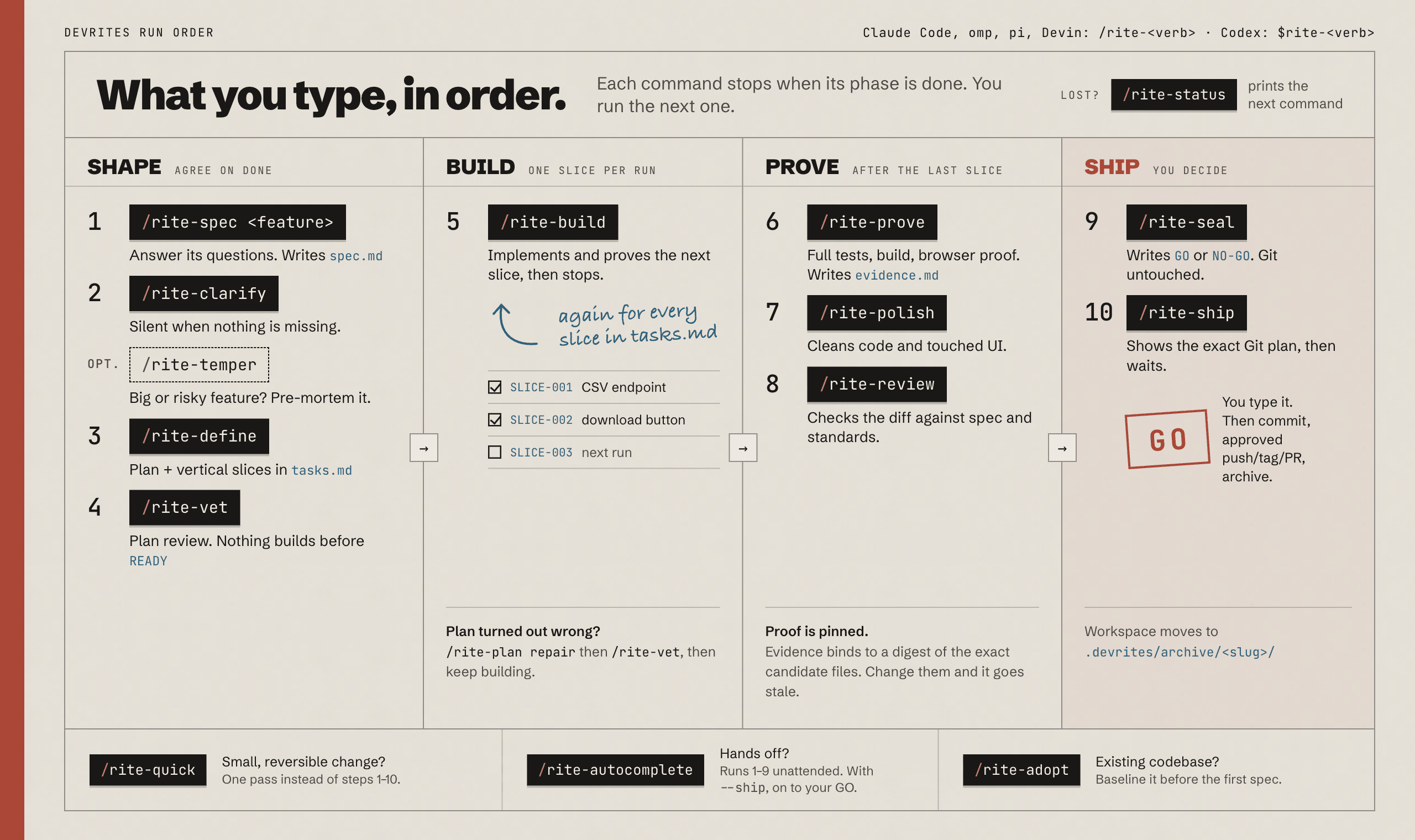
/rite-vet: review the plan before build
Vet each plan: scope, architecture, quality, proof, performance, failures, writer
safety. Fold cited technical findings; design Build tests. Temper owns product,
Vet implementation. Current $ARGUMENTS (--full) feeds reference/depth.md
triggers; profiles never remove the exact plan-reviewer gate
(orchestration-profiles.md).
Rules
Read the active standard from: principles.md, patterns.md + coding-style.md (over-engineering / YAGNI rubric, trigger yagni),
testing.md, spec-grammar.md, performance.md, error-handling.md (trigger errors),
development-workflow.md, afk-hitl.md, one-shot-actions.md,
developer-experience.md, elicitation.md, and definition-of-done.md (trigger dod). Load
repository topology, data integrity, and integration reliability only when
triggered (trigger applicability). When the plan's scope generalizes an existing boundary — a second
platform/tenant/source of truth, a newly optional field, a constant turned parameter —
confirm the assumption-checkpoints.md question (trigger assumption-delta)
was answered and recorded, not skipped-as-negative.
Before classifying any Reslice, read .dsh/skills/devrites-lib/reference/standards/acceptance-preserving-reslice.md.
When a
plan declares a root-authored executable workflow file, read
workflow-artifacts.md.
FOLD→ fold technical topology; invalidate Vet/readiness; affected Vet before Build.GUARD_AND_REPAIR→ no planning writes; Spec Drift Guard → Clarify → Plan repair → affected Vet.BLOCKED_INPUT→ no planning writes; exact diagnostic; recover input; reclassify.
Invariants
- Review implementation, not ambition. Challenge creep/complexity/proof/risk without changing accepted product scope.
- Root owns decisions/writes/readiness; reviewers judge, not route. Cite
findings/confidence; suppress unverified or confidence ≤4 findings per
review-axes.md.eng-lenses.mdarrows are heuristics; use only the fourreview-axes.mdband names. - Auth, migration, public API, and data-model changes need maximum caution, full review, and explicit rollback. Pause only for canonical irreversible-risk items or unresolved human-owned decisions, not an already-approved reversible internal data-model change. Project principles never become trade-offs.
- Governance-protected paths (
.devrites/**, pack skill/agent trees,NOTICE.mdgenerator regions, documented CI/hook config) require explicit human approval before plan slices edit them; absent approval → Vet NEEDS CLARIFICATION. - Use lowest axis band; never average/round thin to ready. Search; resolve reversible technical choices; ask only human-owned.
- Preserve a valid technical return cursor. Agent-owned
NEEDS REPLANreturns internally to its caller, not to the human; on a direct invocation there is no caller, so Vet becomes it — save a return cursor (return_phase/return_next_action) naming this Vet pass as the caller and invoke/rite-planrepair inline under the same fingerprint caps. An agent-owned verdict with budget remaining is never a user-facing command. - Recovery recheck is bounded and batched. A valid cursor plus open fingerprints enters Recovery recheck; it does not start another Full Vet or repeat unaffected axes/reviewers. One dispatch covers every open fingerprint of the fold — each checked individually — with a mandatory correction-created regression audit.
- Refuse the rationalizations in
anti-patterns.
Workflow
Orient. Read core. Resolve source per phase target binding, require state, and read plan, tasks, spec, decision coverage, optional strategy/design brief, decisions, assumptions, and state. Require approved Plan and
Decision coverage: CLEAR; otherwise stop for Define or Clarify. Check placement (get_architecture), blast radius (trace_path), and reuse (search_graph) percode-navigation.md. Under Autocomplete, return scheduling for its global frontier pass before cold/local recovery; preserve Vet's source-local return cursor.Select depth. Apply
reference/depth.mdexactly; never skip. Initial passes record engineering verdict and test-plan coverage. Valid Recovery rechecks retain prior depth; enter 1b. 1a. Independent initial pass. Freeze candidate; dispatch exact fresh read-only plan reviewer, plus developer-experience reviewer for developer surfaces (triggerdevex) and current strategy reviewer after significant Temper, in parallel under../devrites-lib/reference/parallel-dispatch.md: independent read-only passes on one frozen candidate. Missing required account blocks. Meanwhile run root steps 2–4, including step 3 preflight commands, on that candidate. Under Autocomplete, before native wait return scheduling to its global frontier pass with reviewer handles retained; standalone Vet stays source-local. Apply the shared protected validation window and identity recheck before reconciling returned accounts. 1b. Recovery recheck. Require valid return cursor, accepted prior finding, exact fingerprint/reproduction, repaired candidate identity, changed paths/criteria, affected drift/evidence, and the recorded delta self-check. Freeze that packet and dispatch each exact owning reviewer once, fresh/read-only, limited to it — all its open fingerprints in that dispatch. Under Autocomplete, before native wait use the same controller pass and retained handles as step 1a; standalone Vet stays source-local. Apply the same protected-window account admission. Do not rerun broad inventory or unaffected reviewers. Close the prior fingerprint only with discriminating evidence plus an explicit correction-created regression verdict on the touched invariants (acyclic deps, traceability, contract proof, sizing) and every region depending on a changed clause — enumerate dependents via the dep graph and traceability refs, not only patched sites. Otherwise record one no-progress outcome. A different Critical/Important invariant needs exact evidence and a new fingerprint; a Suggestion, Nit, or FYI cannot keep recovery open. ReviewerLate:rows on unchanged clauses follow the canonical late-finding rule: Critical with a failure path → new fingerprint; otherwiseeng-review.md## Deferred findings(mechanism rows become one proof row at step 6). A packet markedconvergence_pressureaccepts an explicit, bounded declared residual/limitation folded into the contract text as closure for a finding marked as a refinement of an already-pinned clause; the recheck may re-raise it only by naming a concrete failure path the declaration omits. Anew_failure_modefinding is never residual-eligible. A fold whose findings are allmechanismkind or Suggestion-or-lower rechecks mechanically at the materialization gate — anchors applied (a cleanstate apply-bundle), mirrors consistent, invariants pass — without a dispatched reviewer; sub-Important findings already cannot keep recovery open. Reconcile shared artifact/readiness gates, then enter step 8 or the next repair. Do not fall through to steps 2–7. Retain evidenced unchanged coverage; changed global contract/uncertain impact requires full applicable review. Reopen historical findings only for affected invariants/dependencies.Challenge scope. Apply review-axes §0; search accepted decisions. Harden to the smallest contract-complete plan, using marked topology action. Then verify bidirectional ID-and-meaning traceability across spec/plan/ tasks/test-plan/traceability, acceptance, terms, principles, anti-slop, and conventions; every slice and test-plan row maps to a live requirement and vice versa. Critical gaps/unexcepted principle breaches block. Record rechecked result in
eng-review.md§2 (Scope challenge).Preflight Build entry. Under
reference/artifacts.md, verify exact command/cwd/tool/version/prerequisite; output filters must preserve upstream failure. Verify dependencies from authoritative source plus nearest manifest. Run parser-sensitive syntax only in isolated fixtures. Remeasure mutable facts; live evidence wins, conflict marks stale, and unmeasurable conflict is a gap. Record complete SHA-256 provenance. Every behavioral mapping names a positive discriminating assertion and decisive signal, never only exit zero.For each consumptive action, bind every
reference/artifacts.mdConsumptive action gates column; every fingerprint identifies one actionable seam; aliasing multiple emit sites is a gap. Preflight observes but need not make future behavior pass, except that a manifest/lockfile edit is dry-run now: before READY rundevrites-engine check preconditions <slug>(rows withRun atvet, including eachdependency-dry-runand preserve-baseline row). A failure folds into Plan repair; only an owner-owned decision becomes a question, batched under the afk-hitl decision-chain rule.Audit readiness. For explicit workflow-only tasks, follow
workflow-artifacts.md: check AC/REQ → admitted WA behavior and executable proof, all admission fields, fixtures, bounds and root ownership, not product slice writer/closure checks. Keep empty product candidate and zero built slices; no Build/wright dispatch. Missing/malformed admission routes Plan; stale admission requires fresh Vet and ordinary readiness SHA binding. Never switch ACTIVE for a named workspace. Otherwise goal-backward map every requirement, criterion, NFR, interaction, edge/prohibition, and decision row to one slice and executable proof. Verify UX/spec/architecture alignment, contracts, dependency order, slice independence/wiring, prerequisites, failure/observability/rollback, and ownership. The plan'sShared contract proofnames one reused boundary artifact plus two consuming tests for every changed API/event/schema/provider- consumer seam, or an explicit no-impact statement. Missing, one-sided, duplicated-contract, vague, or non-consuming proof fails closed. Each slice names a fast writer-safe check its wright can run; proof reachable only through root-owned full gates is amechanismfinding.Technical gaps are
NEEDS REPLANand Plan repair — each finding marks itselfnew_failure_modeor names the already-pinned clause/fingerprint it refines, making alias-detection andconvergence_pressureeligibility mechanical — and carrieskind: contract | mechanism(review-axes.md§ Finding kind). Onlycontractfindings open a Plan repair; amechanismfinding is closed by onetest-plan.mdproof row at step 6 and leaves readiness intact when nothing else is open. Product/risk gaps areNEEDS CLARIFICATIONand Clarify. Neither becomes a Build qid.Review axes. Apply
review-axes.mdthrougheng-lenses.md. Fold verified behavior-preserving technical findings; walk only human-owned decisions. Profile gate ceiling and Reslice marked action remain authoritative.Write outputs. Produce every artifact in
reference/artifacts.md. After editing intent/decision/assumption/question owners, re-scan affected coverage, assumptions, uncertainty, and gates. Keep state non-READY. Every scenario and criterion needs positive, discriminating proof; every slice must be one-pass implementable; developer plans (triggerdevex) write the devex reviewer's predicted scorecard todevex.md. Durable commands are portable repository commands, not host wrappers — resolve them withdevrites-engine detect commands(Makefile/package.json/manifests, no execution) and cite the resolved text verbatim; anunresolvedslot means name the concrete command in the plan, never guess one. Once the## Build-entry preflighttable is final, rundevrites-engine gates scaffold <slug>to seedgates.md(one pending gate perAC-###; never clobber an existing ledger), then author each gate'sCHECK/EXPECT/CWDper artifacts.md §gates.mdso every runnable oracle is an approved preflight row. Rundevrites-engine gates lint <slug> --strictand resolve every finding before READY; the readiness check refuses a missing or malformed ledger but does not replace this oracle-quality gate.Narrow recheck after edits. A slice-bound recheck builds its bundle and opens its wave with
--slice <SLICE-ID>per affected slice (every 5 rechecks per slice need a reslice review, as in Build). Workflow Artifact bytes-only: afterOFFLINE_RECOVERY, a correction leaving every admission/WA-*row unchanged recordsWorkflow Artifact reviewed identity: <re-preflight identity digest>below the admission block; whencheck driftreports onlyreviewed-identity-only, the reviewer is one freshdevrites-code-revieweron the prior-source→re-preflight diff against those rows (no drafter or plan reviewer); green proceeds to step 8. Otherwise dispatch the exact plan reviewer once per fold — one dispatch covering every open fingerprint, preserving per correction/fingerprint accounting (each checked individually with its accepted findings, changed paths/criteria, new identity, and recorded delta self-check); it must return an explicit correction-created regression verdict over touched invariants plus every dependent of each changed clause (dep-graph and traceability lookup), not only fingerprint closure. Within one correction, no broad third loop. If it changes plan, fold again. A closed input plus a distinct Critical/Important invariant returns that new fingerprint as progress. Then close matrix and rerun ID/meaning audit.Build readback and readiness. Add a cited five-line readback to
eng-review.md(artifacts.md §7 rows 1–5): outcome/ACs; IN/OUT/must-NOT; UI direction and architecture/ critical flow; slice order/first slice; decisive proof/action-time gates. No implementer should need to invent product, architecture, or proof. Contradiction, ownerlessness, or material ambiguity blocks via Clarify or Plan.Write exactly one
Implementation readiness: READY,NEEDS CLARIFICATION, orNEEDS REPLAN. Root sets READY after every account, checklist, preflight, and sweep is green, including thespec-grammar.mdmarker sweep whosemarker sweep:line is recorded ineng-review.md; a kept hit blocks READY. Write phase/next step and emit oneReadiness inputs SHA-256withdevrites-engine check readiness --emit-binding <slug>; normal readiness check must pass; workflow-only checks admission instead. For product work it replays Build-entrycheck sliceon every unbuilt slice, so READY needs each to pass (fix failures in/rite-plan). READY also needs every unbuilt slice's write set closed against the live tree (plan-reviewer dimension 6), so frontier gaps fold in one Plan repair, not one per slice; an affected recheck also closes every unbuilt slice and never defers a closure row. A future sequence workspace prepared by lookahead or the main controller recordsPredecessor readiness: <predecessor> <digest>from the predecessor's--emit-bindinghex; readiness re-checks it. Apply the native dependency-safety axis to its explicit workspace declarations before early admission; stale assumptions need affected re-Vet, never automatic rebinding. Record the per-input drift baseline alongside it:devrites-engine check drift <slug> --record— a later stale binding then names the exact artifact that moved instead of "something changed". AnADVISORY proportion:line names a slice whose proof outgrew its ACs: move its rows without aProvesspec line toDeferred hardeningbefore READY, never deepen them. Technical failure records reproduction, not qid. Human gap awaits Clarify. Optional cross-model followsreference/cross-model.md(triggercross-model).With READY, no pending remediation, and a valid technical return cursor, restore and consume the return cursor instead of defaulting to Build. Preserve it through admitted remediation. Only a real stop reaches the human.
Stop at the Vet boundary. Show Build readback, scope verdict, lowest axis, closed gaps, preflight, action checkpoints, and critical failures. Recommend Build only when READY.
Do not replace interactive review with artifacts, change acceptance through hardening, score without source evidence, or ignore unexplained complexity.
Phase exit
Complete when: eng-review.md records exactly one readiness verdict, readiness
binding SHA-256 passes, and every required reviewer account is admitted.
Failing case: READY written while a required reviewer returned Outcome: gap →
not complete; restore NEEDS REPLAN or dispatch missing reviewer.