research-catalog
Purpose
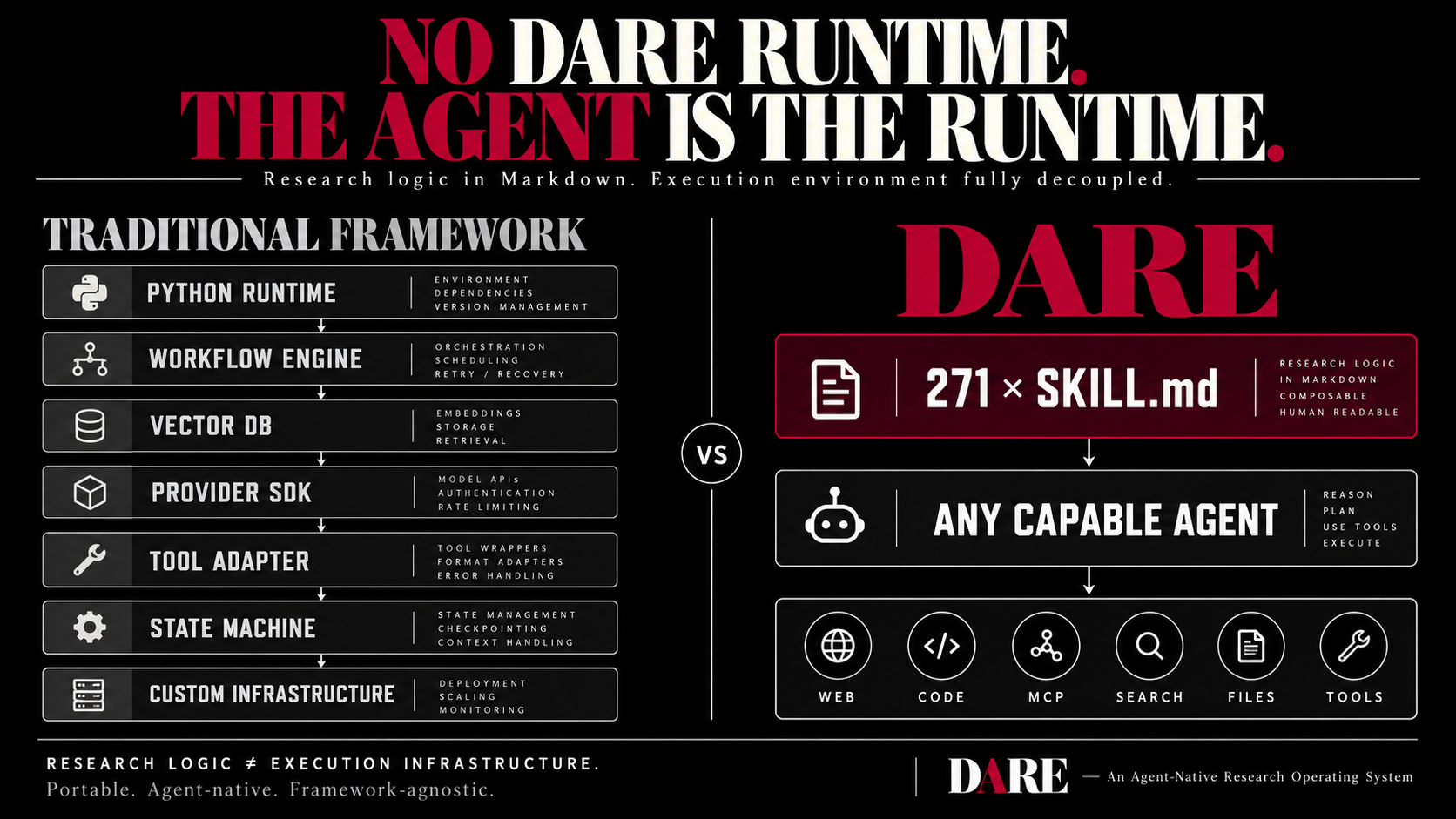
This is the v4 capability menu. It indexes exactly 51 tactics in 10 families and tells the caller when each tactic is useful. It does not list SOPs. A selected tactic owns its SOP calls through You MUST load skill ... instructions in the tactic body.
Input Contract
required: [confirmed_north_star, research_brief]
optional: [current_spec_view, state_slice, constraints]
constraints:
  - return tactic cards, not SOP cards
  - preserve the tactic id exactly as listed
Execution Protocol
Read the North Star, ResearchBrief, current SpecView, and relevant state slice. Select 3-5 candidate tactics whose purpose and prerequisites match the current objective. Return their family, id, why-now condition, required inputs, expected outputs, and next call. Do not invent an order for tactics that the Spec has not ordered. Once a tactic is selected, the caller MUST load that tactic skill; its body is authoritative for SOP calls and thresholds.
Tactic Index
ACQUISITION
| Tactic |
When to use |
synthesize-literature-evidence |
When the question needs a structured synthesis of literature claims and evidence. |
mine-patent-landscape |
When patents, assignees, classifications, or filing trends define the search space. |
assess-prior-art-and-claims |
When a proposed contribution must be tested against prior art and claim boundaries. |
map-patent-white-space |
When patent coverage and uncrowded opportunity regions must be compared. |
audit-benchmark-validity |
When benchmark metrics, datasets, or comparison protocols may distort conclusions. |
synthesize-meta-analytic-evidence |
When multiple studies provide comparable effect estimates requiring pooled interpretation. |
establish-empirical-baseline |
When a new method needs a reproducible baseline and a defensible comparison reference. |
CONVERGENCE
| Tactic |
When to use |
pairwise-ranking |
When candidates are easier to compare two at a time than on a shared absolute scale. |
structured-consensus |
When several judgments must be reconciled with explicit disagreement and evidence. |
portfolio-optimization |
When the result should be a balanced subset rather than one winner. |
CROSS
| Tactic |
When to use |
rank-candidates |
When typed candidates must be scored, screened, classified, or selected under stated criteria. |
map-validity-envelope |
When the conditions under which a claim or design remains valid are unknown. |
explore-dimensional-space |
When a design space needs axes, combinations, and coverage gaps. |
adversarial-deliberation |
When a consequential decision needs structured opposing cases before commitment. |
analyze-constraints-readiness |
When constraints, dependencies, conflicts, and readiness determine whether work can proceed. |
DIRECTION
| Tactic |
When to use |
map-research-landscape |
When fields or subfields must be compared by maturity, competition, barriers, and opportunity. |
decompose-research-goal |
When a broad goal must become ordered, testable objectives and dependencies. |
EXPERIMENT
| Tactic |
When to use |
design-experiment |
When hypotheses need factors, variables, controls, measurements, and analysis plans. |
analyze-future-scenarios |
When a design or strategy must be tested against plausible future conditions. |
analyze-experiment-results |
When observations must be interpreted against the preregistered design and gates. |
HYPOTHESIS
| Tactic |
When to use |
formulate-hypotheses |
When observations or gaps must become structured, named, testable hypotheses. |
falsifiability-audit |
When a hypothesis needs explicit disconfirmation conditions and observable consequences. |
formulate-research-question |
When an intent must become a precise, bounded research question. |
decompose-research-question |
When one question contains separable subquestions with distinct evidence needs. |
IDEATION
| Tactic |
When to use |
analogical-discovery |
When another domain may provide a transferable mechanism or design pattern. |
destructive-ideation |
When assumptions should be inverted or deliberately broken to expose alternatives. |
structural-transformation |
When an existing concept should be decomposed and recombined structurally. |
coverage-white-space-search |
When the candidate space is incomplete and missing regions need systematic search. |
resolve-inventive-contradiction |
When requirements conflict and a solution must preserve both sides. |
biomimetic-transfer |
When biological functions or mechanisms may transfer to the target problem. |
conceptual-blending |
When two or more concept spaces should be combined to produce emergent candidates. |
evolve-solution-population |
When iterative variation and selection are more useful than one-shot ideation. |
INSIGHT
| Tactic |
When to use |
validate-research-gap |
When an alleged gap needs evidence, novelty, and boundary verification. |
drill-root-causes |
When surface symptoms must be traced to mechanisms and contributing conditions. |
assumption-stress-test |
When hidden assumptions may determine whether a conclusion survives. |
robustness-analysis |
When conclusions must be checked across perturbations, alternatives, or distributions. |
sensitivity-analysis |
When priority depends on which inputs or assumptions drive the result. |
problem-reframing |
When the current problem statement may encode an unhelpful framing or boundary. |
map-stakeholder-system |
When actors, incentives, dependencies, and tensions shape the research problem. |
STRESS
| Tactic |
When to use |
structured-red-team |
When an artifact needs organized attacks from distinct critical perspectives. |
fmea-risk-analysis |
When failure modes should be enumerated, rated, and mitigated before execution. |
counterfactual-causal-analysis |
When causal necessity or sufficiency must be tested by counterfactual changes. |
reductio-counterexample-analysis |
When a claim can be challenged by deriving consequences or counterexamples. |
falsification-first-audit |
When the fastest route to confidence is to seek decisive disconfirmation. |
audit-structural-equivalence |
When two artifacts may be equivalent in structure despite different wording. |
audit-validator-independence |
When a validator may share assumptions or evidence with the artifact it checks. |
audit-convergence-independence |
When multiple routes to a conclusion may not be genuinely independent. |
audit-explanatory-compression |
When a compact explanation may be hiding unsupported jumps or omitted variables. |
STRUCTURING
| Tactic |
When to use |
build-domain-ontology |
When concepts and relations need a stable hierarchy and vocabulary. |
construct-causal-model |
When variables, mechanisms, and causal dependencies need explicit structure. |
construct-argument-map |
When claims, reasons, objections, and evidence need an inspectable argument graph. |
Output Contract
produces: [tactic_cards, selection_rationale, next_call]
tactic_card_fields: [id, family, when_to_use, requires, produces, source_ref, next_call]
Completion Criteria
The response contains only valid tactic ids from the 51-item index, gives a reason for each selected card, and maps each card to its source body. No SOP is presented as a menu choice.
Failure and Backtrack
If the North Star or scope is too vague to select a tactic, return NEEDS_CONTEXT and list the missing fields. If no card meets the current gate, retain the Spec stage and report the mismatch; do not substitute a generic prompt or silently choose an unrelated tactic.
Boundary
The catalog is a product-shell index. It is not a third graph layer and does not create edges or replace the tactic body as the authority for scientific contracts and SOP calls.
1---2name: research-catalog3description: "This is the v4 capability menu. It indexes exactly 51 tactics in 10 families and tells the caller when each tactic is useful."4metadata:5 source: https://skillmd.com/skills/yogsoth-ai/research-catalog6---78# research-catalog910## Purpose1112This is the v4 capability menu. It indexes exactly 51 tactics in 10 families and tells the caller when each tactic is useful. It does not list SOPs. A selected tactic owns its SOP calls through `You MUST load skill ...` instructions in the tactic body.1314## Input Contract1516```yaml17required: [confirmed_north_star, research_brief]18optional: [current_spec_view, state_slice, constraints]19constraints:20 - return tactic cards, not SOP cards21 - preserve the tactic id exactly as listed22```2324## Execution Protocol2526Read the North Star, ResearchBrief, current SpecView, and relevant state slice. Select 3-5 candidate tactics whose purpose and prerequisites match the current objective. Return their family, id, why-now condition, required inputs, expected outputs, and next call. Do not invent an order for tactics that the Spec has not ordered. Once a tactic is selected, the caller MUST load that tactic skill; its body is authoritative for SOP calls and thresholds.2728## Tactic Index2930### ACQUISITION3132| Tactic | When to use |33| --- | --- |34| `synthesize-literature-evidence` | When the question needs a structured synthesis of literature claims and evidence. |35| `mine-patent-landscape` | When patents, assignees, classifications, or filing trends define the search space. |36| `assess-prior-art-and-claims` | When a proposed contribution must be tested against prior art and claim boundaries. |37| `map-patent-white-space` | When patent coverage and uncrowded opportunity regions must be compared. |38| `audit-benchmark-validity` | When benchmark metrics, datasets, or comparison protocols may distort conclusions. |39| `synthesize-meta-analytic-evidence` | When multiple studies provide comparable effect estimates requiring pooled interpretation. |40| `establish-empirical-baseline` | When a new method needs a reproducible baseline and a defensible comparison reference. |4142### CONVERGENCE4344| Tactic | When to use |45| --- | --- |46| `pairwise-ranking` | When candidates are easier to compare two at a time than on a shared absolute scale. |47| `structured-consensus` | When several judgments must be reconciled with explicit disagreement and evidence. |48| `portfolio-optimization` | When the result should be a balanced subset rather than one winner. |4950### CROSS5152| Tactic | When to use |53| --- | --- |54| `rank-candidates` | When typed candidates must be scored, screened, classified, or selected under stated criteria. |55| `map-validity-envelope` | When the conditions under which a claim or design remains valid are unknown. |56| `explore-dimensional-space` | When a design space needs axes, combinations, and coverage gaps. |57| `adversarial-deliberation` | When a consequential decision needs structured opposing cases before commitment. |58| `analyze-constraints-readiness` | When constraints, dependencies, conflicts, and readiness determine whether work can proceed. |5960### DIRECTION6162| Tactic | When to use |63| --- | --- |64| `map-research-landscape` | When fields or subfields must be compared by maturity, competition, barriers, and opportunity. |65| `decompose-research-goal` | When a broad goal must become ordered, testable objectives and dependencies. |6667### EXPERIMENT6869| Tactic | When to use |70| --- | --- |71| `design-experiment` | When hypotheses need factors, variables, controls, measurements, and analysis plans. |72| `analyze-future-scenarios` | When a design or strategy must be tested against plausible future conditions. |73| `analyze-experiment-results` | When observations must be interpreted against the preregistered design and gates. |7475### HYPOTHESIS7677| Tactic | When to use |78| --- | --- |79| `formulate-hypotheses` | When observations or gaps must become structured, named, testable hypotheses. |80| `falsifiability-audit` | When a hypothesis needs explicit disconfirmation conditions and observable consequences. |81| `formulate-research-question` | When an intent must become a precise, bounded research question. |82| `decompose-research-question` | When one question contains separable subquestions with distinct evidence needs. |8384### IDEATION8586| Tactic | When to use |87| --- | --- |88| `analogical-discovery` | When another domain may provide a transferable mechanism or design pattern. |89| `destructive-ideation` | When assumptions should be inverted or deliberately broken to expose alternatives. |90| `structural-transformation` | When an existing concept should be decomposed and recombined structurally. |91| `coverage-white-space-search` | When the candidate space is incomplete and missing regions need systematic search. |92| `resolve-inventive-contradiction` | When requirements conflict and a solution must preserve both sides. |93| `biomimetic-transfer` | When biological functions or mechanisms may transfer to the target problem. |94| `conceptual-blending` | When two or more concept spaces should be combined to produce emergent candidates. |95| `evolve-solution-population` | When iterative variation and selection are more useful than one-shot ideation. |9697### INSIGHT9899| Tactic | When to use |100| --- | --- |101| `validate-research-gap` | When an alleged gap needs evidence, novelty, and boundary verification. |102| `drill-root-causes` | When surface symptoms must be traced to mechanisms and contributing conditions. |103| `assumption-stress-test` | When hidden assumptions may determine whether a conclusion survives. |104| `robustness-analysis` | When conclusions must be checked across perturbations, alternatives, or distributions. |105| `sensitivity-analysis` | When priority depends on which inputs or assumptions drive the result. |106| `problem-reframing` | When the current problem statement may encode an unhelpful framing or boundary. |107| `map-stakeholder-system` | When actors, incentives, dependencies, and tensions shape the research problem. |108109### STRESS110111| Tactic | When to use |112| --- | --- |113| `structured-red-team` | When an artifact needs organized attacks from distinct critical perspectives. |114| `fmea-risk-analysis` | When failure modes should be enumerated, rated, and mitigated before execution. |115| `counterfactual-causal-analysis` | When causal necessity or sufficiency must be tested by counterfactual changes. |116| `reductio-counterexample-analysis` | When a claim can be challenged by deriving consequences or counterexamples. |117| `falsification-first-audit` | When the fastest route to confidence is to seek decisive disconfirmation. |118| `audit-structural-equivalence` | When two artifacts may be equivalent in structure despite different wording. |119| `audit-validator-independence` | When a validator may share assumptions or evidence with the artifact it checks. |120| `audit-convergence-independence` | When multiple routes to a conclusion may not be genuinely independent. |121| `audit-explanatory-compression` | When a compact explanation may be hiding unsupported jumps or omitted variables. |122123### STRUCTURING124125| Tactic | When to use |126| --- | --- |127| `build-domain-ontology` | When concepts and relations need a stable hierarchy and vocabulary. |128| `construct-causal-model` | When variables, mechanisms, and causal dependencies need explicit structure. |129| `construct-argument-map` | When claims, reasons, objections, and evidence need an inspectable argument graph. |130131## Output Contract132133```yaml134produces: [tactic_cards, selection_rationale, next_call]135tactic_card_fields: [id, family, when_to_use, requires, produces, source_ref, next_call]136```137138## Completion Criteria139140The response contains only valid tactic ids from the 51-item index, gives a reason for each selected card, and maps each card to its source body. No SOP is presented as a menu choice.141142## Failure and Backtrack143144If the North Star or scope is too vague to select a tactic, return `NEEDS_CONTEXT` and list the missing fields. If no card meets the current gate, retain the Spec stage and report the mismatch; do not substitute a generic prompt or silently choose an unrelated tactic.145146## Boundary147148The catalog is a product-shell index. It is not a third graph layer and does not create edges or replace the tactic body as the authority for scientific contracts and SOP calls.